
top of page

Dressed to Resist: Boots Riley’s I Love Boosters is a Wacky Must-See

Boots Riley’s I Love Boosters is a passionate, beautifully maximalist critique of capitalism and an ode to community. Though the filmmaker, musician, and activist has only released two feature films in his career, he has already built a strong, unique style: combining activism with eccentricity.

But what is a booster? As Boots Riley’s band The Coup explains in their 2006 song “I Love Boosters”, “A booster is a person who jacks from the retail and sells it in the hood for dirt-cheap resale” 

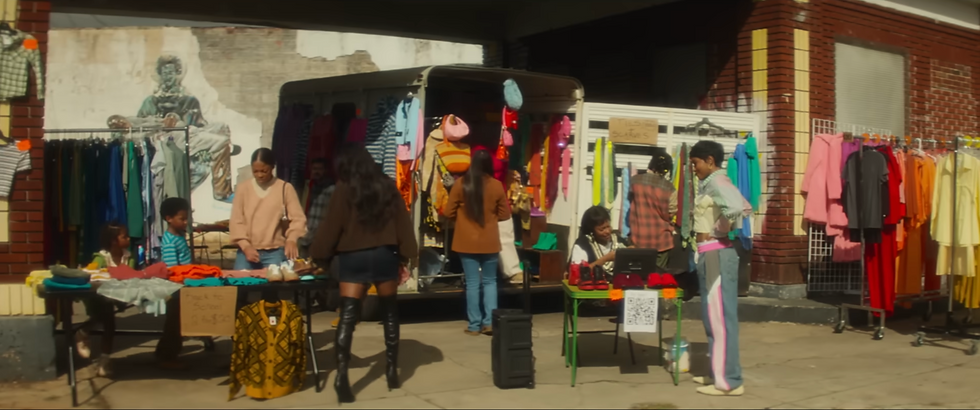
Based in an alternate version of Oakland, California, the film follows a group of boosters reselling stolen designer goods. Keke Palmer, Taylour Paige, Naomi Ackie, and Poppy Liu deliver magnetic performances as women navigating a world where identity is increasingly defined by brands and the illusion of status. Demi Moore appears as their target, a ruthless fashion mogul embodying the power hungry centre of the industry, while LaKeith Stanfield brings a surprisingly offbeat, otherworldly energy to his incredibly memorable role as Palmer’s romantic interest. Eiza González, Will Poulter, and the unrecognizable Don Cheadle round out the cast with hilariously quick-witted and outstanding performances that further amplifies the film’s surreal atmosphere. 

Riley’s sophomore feature follows the extravagantly odd Sorry to Bother You (2018), a surreal science fiction piece with a darkly comedic edge about a telemarketer who discovers an unusual key to climbing the corporate ladder, which lands him in a world of greed, bigotry, and bodily mutations. Similarly, I Love Boosters is fiercely anti-capitalist, but this time Riley pushes the chaos even further, going through themes of materialist obsession, classism under capitalism, harmful fast fashion, and workers rights.

The film establishes a stylish spectacle while simultaneously dismantling the systems that make spectacle profitable in the first place. When asked about the struggles of making politically radical cinema within the capitalist industry, Riley points to the contradiction itself by utilizing the same systems and distribution structures he critiques to attempt to bend them toward a vision of working-class power, collective ownership, and systemic change. The film does not beat around the bush with its political intent. Riley approaches leftist ideology with artistically bold choices and direct confrontation. The fashion industry in I Love Boosters becomes a playing field for exploring class conflict and labour exploitation. Riley does not waste any time establishing both character and motive. Early on, it is understood that the boosters cannot be classified as thieves driven by greed, but people suffocated by an economic system that constantly reminds them they are disposable. 

The incredibly unique costume design led by Shirley Kurata, known for her work on Everything Everywhere All at Once, plays into the absurdity, as well as being a main contributor to the film's visual language of identity and class. Kurata and Riley are quick to develop a stunning monochromatic visual language whenever clothing or branding dominates the frame, creating an aesthetic that turns retail culture into something bright, but ultimately exhaustingly reproduced. 

Beneath the glamour that Demi Moore’s luxury brand is idolized with, lies the exploitation of its workers. The film repeatedly points toward sweatshop labour and the bodily harm of manufacturing fast fashion. One plotline involving a dangerous fabric production process ties the fashion industry directly to the worker’s physical sickness, making the connection between consumer desire and worker suffering impossible to ignore. As well, Riley highlights the almost Robinhood-like efforts the group of boosters does for their community who cannot afford the products at their original prices, referring to their work as “Fashion-Forward-Philanthropy”. With this, Riley constantly reminds the audience that luxury only exists because exploitation does.

At the center of the film is a longing for connection and comfort that capitalism continually interrupts. Corvette’s desire for intimacy and belonging struggles against a world built around commodification and transactional relationships. Haunted by a literal mass of receipts and eviction notices, she is ridden with loneliness and alienation, commenting on how her entire existence has been reduced to reminders of a life she can not afford to sustain. Riley pushes his ideology with anger at the system as well as a genuine care for people trying to survive within. The film’s recurring emphasis on community and labour solidarity gives its rage emotional weight.

Musically, the film pulses with vibrancy. The eccentric score composed by duo Tune-Yards, with recurring highlights like “Hi-Ho” and “Pinky Ring Dude”, reinforces the film’s manic energy and rebellious spirit. Riley creates a truly maximalist sensory experience where sound, colour and movement constantly collide. The transitions are sharp and creative, practical effects done with miniatures and claymation increase the absurdity, and the monochromatic visuals transform consumer culture into something hypnotic and comically unsettling all at once. 

I Love Boosters is messy, radical, and unapologetically driven by politics in a specific way no other modern studio films dare to be. It is a visually stunning, passionate critique of capitalism and material obsession, as well as a celebration of community, labour resistance, and human connection under systems designed to suppress it. Provocatively funny and aesthetically unforgettable, Boots Riley puts his anti-capitalist rage into a must-see film bursting with ambition.


1 Comment


trip2vips
May 26

best

Like
INTERVIEWS
RECENT POSTS

© 2023 by New Wave Magazine. Proudly created by New Wave Studios

bottom of page