

top of page

The Inherent Need for Period Accuracy in a Modern Age; Sense and Sensibility

31 minutes ago
4 min read

We are no stranger to the works of Jane Austen, and over time she has cemented herself as one of the great authors of the past. Her works have a certain quality that seems to speak to us. Whether we have studied her works in school or read her stories in our spare time, there will have been a moment in our lives when her works affected us the most, which is perhaps one of the most beautiful things about storytelling.


And, of course, when we have a work as esteemed as Jane Austen’s, there are bound to be many adaptations, which truly just shows the depths of her brilliance and the continuous adaptability of her work, even now. Perhaps in a time when such stories aren't really paid as much attention as they might once have been. And over the years, through the many adaptations that have come from this material. A fan favourite being the work of Emma Thomspon, though it appears this work may be tied as a close second. 


In a world where everything is so technologically advanced and so quickly adapting and changing, we are constantly looking for new means of escapism, clinging to whatever we can get our hands on that helps us forget what is happening in the world around us. Which is what makes this adaptation so great. We as the audience are transported back in time, we are given the chance to revisit the past and embark on a life we never otherwise would have experienced. We have seen a recent uproar with the likes of Bridgerton, too. There seems to be something so whimsical about the period age that makes us want to spend as much time there as we can, there seems to be a sense of nostalgia for a time we have never personally experienced. 


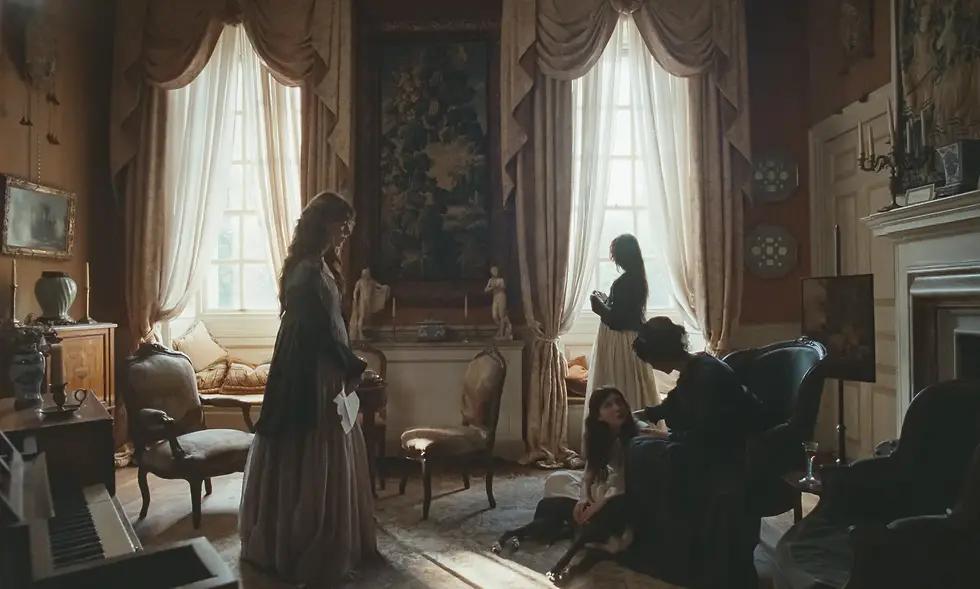
Not only was this beautifully written and directed, but the costumes were as accurate as they could have been, which is one of the most important things when trying to make a period drama, especially one based on pre-existing texts.  But the costumes included within this movie continuously knocked it out of the park, especially with some of the dresses, and we could tell that a fair amount of research had been done.  It only enhanced that feeling of escapism that we then feel as the audience, because sometimes the lack of period accurate costumes can completely take us out of the story and only destroys what it is setting out to do and has the opposite effect that a director would have been hoping for. 


Daisy Edgar Jones and George Mckay deliver an excellent performance as Elinor and Edward, respectively. It truly helped us to understand their characters a little better and the fundamentals of their relationship and why they worked so well. We can truly feel it from the beginning of the movie and it does not seem to waver for the entire thing. The chemistry between the two is so realistic and believable that you cannot help but think that these two would be a true match. Which only helped to sell the story. Everyone in the cast brought their own thing to their own stories. But not only did they seem to excel independently, they also played together wonderfully and it truly felt as though they were a real family. What this adaptation does well is the humour scattered throughout, in what could be such a heavy story at times, it is important that there is at least some sense of comedic relief which Georgia Oakley seemed to capture exceptionally well. 


One of the few things that did not work as well was the depiction of Marianne at times. In the book, at times, Marianne is described as a beauty driven by passion. Out of the two sisters, she is considered to be the more gorgeous sister.  But in this adaptation, she seems to be shown as one with nature, continuously appearing on screen in somewhat of a dishevelled manner which seemed incredibly out of character for her and did not work in Oakley’s favour. 


And, a brief spoiler warning before we advance, the scene where Elinor runs after Edward after learning that he is not married as they once thought him to be seemed reminiscent  of the confession scene in Greta Gerwig's little women when Laurie confesses the true nature of his feelings to jo up on the hill, even the framing mirrors each other and we are left to wonder if perhaps Oakley was inspired by Gerwig when making the film. 


Regardless of that, it’s a good adaptation in its own right and even when taking away the fact that it is based on a pre-existing volume of work, it serves as a standalone period drama, which I like because it then means that anyone and everyone can enjoy the movie without needing to have any prior knowledge of the plot or the characters. 


Comments


INTERVIEWS
RECENT POSTS

© 2023 by New Wave Magazine. Proudly created by New Wave Studios

bottom of page