



top of page

You Wanted a Villain, Digger (2026) Gave You a Mirror

6 hours ago
6 min read
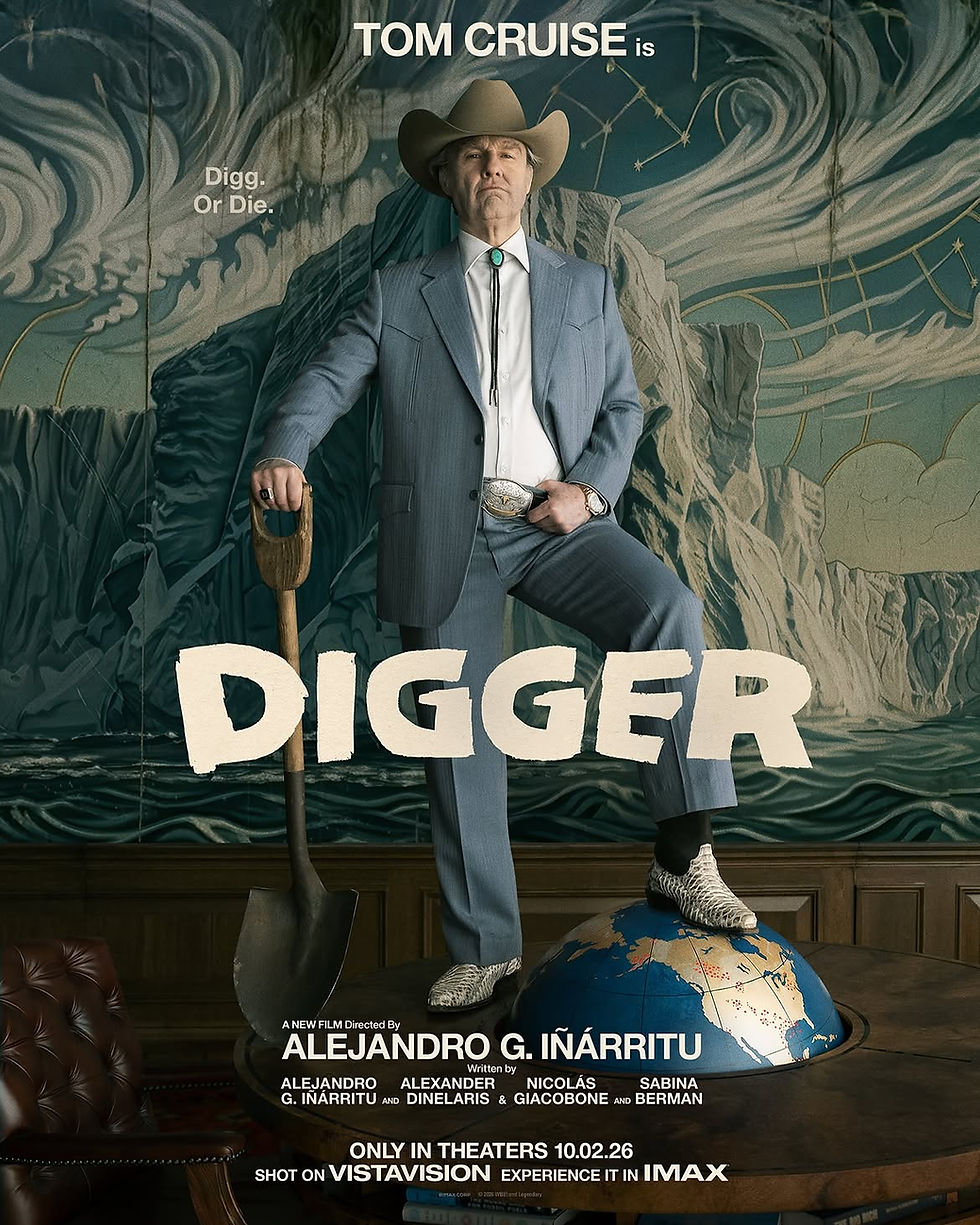
Image: @diggerthemovie / Warner Bros. Pictures 

Most movies about a broken world want you to know who is responsible.

Digger doesn’t.

Alejandro G. Iñárritu’s latest film may look like a story about billionaires, corporate greed, and the destruction of the planet, but reducing it to that would miss what makes the movie so fascinating. We already know the world is being exploited by people with more money and power than most of us could ever imagine. We already know corporations put profit before people. We already know politicians lie and billionaires get away with things ordinary people never could.

None of that is exactly new.

What Digger does differently is turn the question back toward us.

What if knowing the system is broken doesn’t make us innocent?

That idea stayed with me long after the movie ended.

We are incredibly comfortable pointing upward. It’s easy to look at the richest people in the world and say, There they are. That’s the problem. It’s much harder to admit that we also benefit from the same system we criticize.

We want things cheap. We want them immediately. We want convenience. We want technology to make our lives easier. We want everything faster and more accessible, but we rarely want to think about what has to happen behind the scenes to make that possible.

Digger understands that contradiction.

And it refuses to let us escape it.

That’s what makes the film’s satire so uncomfortable. It doesn’t give the audience a simple villain to hate and then send us home feeling morally superior. Instead, it creates a world where almost everyone is participating in something they know is wrong.

The problem isn’t that we don’t know.

The problem is that we know and keep going.

There is something almost cruel about how accurately the film captures the way we consume stories about our own problems. We watch movies about corruption, greed, environmental destruction, and political dysfunction. We laugh at the absurdity. We recognize the references. We talk about the message afterward.

For two hours, we feel like we’re doing something.

Then the lights come on.

We leave the theater and go right back to our lives.

That cycle is at the heart of Digger, and I think it’s one of the reasons the movie is going to frustrate a lot of people. It’s much easier to enjoy a movie when it tells you that the problem belongs to someone else.

Iñárritu doesn’t offer that comfort.

Instead, he throws us into a world so exaggerated that it should feel ridiculous. The performances are enormous. The production is excessive. The characters often feel like exaggerated versions of people we already know. The entire thing occasionally feels like a fever dream.

But that’s where the movie becomes even more unsettling.

Because the longer you watch, the harder it becomes to tell where the satire ends and reality begins.

Iñárritu has reportedly been developing the project for years, but Digger arrives at a moment when the real world has already become so absurd that the movie barely needs to exaggerate it. Political chaos, corporate influence, technological obsession, and the general exhaustion of the post-COVID era have created a reality that can sometimes feel more surreal than fiction.

The film isn’t predicting a dystopia.

It’s looking around and asking why we keep pretending we aren’t already living in one.

Honestly, Cruise might be the most interesting piece of the entire experiment.

After spending years becoming the face of the modern blockbuster, Cruise returns to a dramatic role by playing one of the most obnoxious characters of his career. Digger Rockwell is arrogant, selfish, loud, and completely convinced that his own importance is obvious to everyone around him.

And somehow, Tom Cruise makes him incredibly entertaining.

That shouldn’t be surprising. Cruise has always had a strange gift for playing men who are arrogant or morally questionable without losing their charisma. He can make even the most obnoxious character magnetic.

Here, he pushes that quality much further.

Image: Tom Cruise / Instagram, in partnership with Warner Bros.

Digger is ridiculous, but Cruise never plays him like a joke. There is a genuine person underneath all of the ego and excess. You can laugh at him while still understanding why people follow him.

That’s where Cruise becomes essential to the movie.

We are supposed to be repulsed by Digger.

But we also can’t stop watching him.

Sound familiar?

There is a major speech about halfway through the film that, in lesser hands, could have become another oversized movie-star moment. Instead, Cruise commits to it completely. The scene is theatrical and almost absurd in its scale, but there is a sincerity underneath the performance that caught me completely off guard.

It’s one of my favorite performances Cruise has ever given.

And yes, I think he deserves to be in the Oscar conversation.

Image: Tom Cruise / Instagram, in partnership with Warner Bros.

What makes the performance even more interesting is that Cruise brings his own mythology into the movie. We aren’t just watching an actor play a character. We’re watching Tom Cruise play this character. Decades of movie-star history come with him.

Iñárritu knows that.

The film plays with that relationship between actor, character, and audience throughout. There is a meta quality to Digger that I don’t want to spoil, but the movie repeatedly reminds us that what we’re watching is a construction.

And that leads to one of its most interesting questions:

What happens when the people telling us stories about the world are also part of the world they’re criticizing?

Movies can expose corruption. They can challenge power. They can make us question the systems around us.

But movies can also tell us exactly who we’re supposed to hate.

They can turn complicated issues into simple stories. They can give us a villain, a hero, and a satisfying ending. They can make us feel informed without actually asking us to do anything.

That’s where Digger becomes bigger than its political satire.

It’s also a movie about movies.

About who controls the narrative.

About who gets to decide what stories are worth telling.

And about what audiences actually do with those stories once they leave the theater.

Power isn’t just about money anymore. It is also about attention. Technology companies, media corporations, and entertainment studios have enormous influence over what gets seen, what gets discussed, and what disappears.

The people who contribute to a problem can also become the people who explain the problem to us.

They can sell us the problem.

Then sell us the solution.

Then sell us a movie about both.

And we’ll watch it.

That’s the contradiction Digger keeps returning to.

It doesn’t have all the answers. In fact, I don’t think it is particularly interested in giving us answers. The film is messy because the world it is examining is messy. It contradicts itself because we contradict ourselves.

We want change, but we also want comfort.

We want accountability, but we don’t always want to examine ourselves.

We want someone to blame because admitting that we’re part of the problem is much harder.

That is ultimately where Digger landed for me.

Iñárritu isn’t asking us to figure out who the villain is.

He’s asking what happens when we already know something is wrong and decide to keep participating anyway.

That question has stuck with me.

So has the movie.

I can’t remember the last time I watched something this divisive that I felt so certain would become more interesting with time. I completely understand why someone could hate this movie. I also understand why someone could walk out thinking it’s brilliant.

That’s part of what makes it so fascinating.

Digger feels like a cinematic Rorschach test. What you see in it depends on what you bring into it.

For me, it’s one of my favorite films of the year.

Not because I think it’s perfect. It isn’t.

Not because I agree with every choice Iñárritu makes. I don’t.

I love it because it refuses to make me comfortable.

It made me laugh. It frustrated me. It made me question what I was watching and, more importantly, why I was watching it.

And the more I think about it, the more I believe that’s exactly what Iñárritu wanted.

The easiest thing a movie can do is show us a broken world and tell us who broke it.

Digger does something much harder.

It makes us look in the mirror.

And then it asks us why we’re still looking away.


Comments


INTERVIEWS
RECENT POSTS

© 2023 by New Wave Magazine. Proudly created by New Wave Studios

bottom of page