
top of page

Beneath the Lightning Fist: Inside Asad Raza’s Electricity

39 minutes ago
9 min read

E-WERK Luckenwalde has been generating its own electricity since 2019, when artist Pablo Wendel’s non-profit switched the former brown-coal power station back on as a renewable Kunststrom plant. Its relationship with electricity goes back much further. The station was built in 1913 to supply power to the town, at a time when electricity was still mysterious enough that people called it “cold light.” The building was designed to celebrate this new force, and that faith is set into its fabric with a stained-glass fist hurling lightning bolts sitting above the entrance, where it would have once greeted the plant’s workers. Today it greets visitors, and it serves as the starting point for Asad Raza’s exhibition Electricity, which runs until April 2027.


Ornate arched ceiling with many lit bulbs above a stained-glass window of raised fists in purple clouds and lightning.
E-WERK Luckenwalde entrance, 2019. Image credit: E-WERK Luckenwalde and Ben Westoby.

The doorway is a fixed, material manifesto for electricity’s power, and it opens onto the range of electrical possibilities Raza has us encounter inside. Visitors move through the site in small groups led by a “conductor,” an intimate arrangement that contrasts with the building’s past as a busy industrial plant. That intimacy, between human and electricity, body and machine, carries through even the most mechanical encounters. Electricity appears as radio static, as ash left behind by the earth’s own processes, and even as nourishment for the body. The most intimate moment comes at the exhibition’s climax. The conductor asks visitors to lie down on a stage with a distinctly tarmac-like surface, and as sound fills the room, the electricity can be felt directly beneath you. Raza lets us become one with the energy generated by the building we have just travelled through. Afterwards, visitors return to the domestic calm of a white corridor lined with small cinemas screening films.


Empty industrial hall with overhead crane, cream walls, patterned floor tiles, small doors and windows, softly lit and quiet.
E-WERK Turbine hall. Image credit: E-WERK Luckenwalde and Ben Westoby.

That shift from machinery to the body, and from spectacle to something felt, sits at the heart of how E-WERK has shaped Electricity. For Helen Turner, the institution’s Artistic Director and Chief Curator, the exhibition also signals a deepening of seven years spent working with the physical reality of energy. She describes it as a move toward asking what electricity actually means to us. That question also reaches beyond the power station as this autumn, Smoke and Fire and Electricity brings a David Lynch film and music marathon to Luckenwalde’s Bauhaus Stadttheater, where Lynch’s flickering, uncanny electricity meets Raza’s earthly one. We spoke to Turner about staging a show that questions electricity inside a building made to celebrate it, and about what happens when E-WERK takes its programme out into the town.


Woman in black sits on a leather chair amid large green leaves, wearing a shirt with partial white text and a calm smile.
Artistic Director and Chief Curator of E-WERK Luckenwalde Helen Turner. Image credit: Diana Pfamatter.

E-WERK has worked with ideas of energy since 2019. Wendel's non-profit bought the former brown-coal power station in 2017 to revive it as a renewable Kunststrom plant, and the power was formally switched back on in 2019. Does Electricity feel like a culmination of all of E-WERK’s beliefs about energy and electricity, or does it represent a new direction in the curatorial programme at E-WERK? Why was now the moment for an exhibition named after the institution's core material?


Electricity has been at the centre of E-WERK Luckenwalde from the beginning. We have made exhibitions which entertain the subjects periphery, but never really made an exhibition which uses and discusses the electricity we produce, quite so directly. 


I've spent the last seven years thinking about what happens when you put contemporary art inside an actual power station that is producing energy again, but this time sustainably. So when we began talking with Asad Raza about a solo exhibition, the response to the building was very important to us. We started with a fairly simple question: what could an exhibition about electricity be? Very quickly, that question became enormous.

Through his conversations with the historian of science Simon Schaffer, Asad began thinking about electricity as something not simply technological or infrastructural, but earthly, atmospheric, political, sublime, sinister and intimate, something that moves between bodies, landscapes and systems of power.


That felt very relevant to E-WERK, because we are interested not only in how energy is produced, but in the systems, histories and relationships that surround it. The exhibition has allowed us to move from thinking about electricity as a material infrastructure to thinking about what electricity actually means to us.


So I wouldn't say it's a new direction so much as a deepening of something we've been doing since 2019. We've been working with the physical reality of energy for seven years; now we're asking what happens when you start to think about electricity philosophically, culturally and even ontologically.


And the timing feels right. We are living through a huge transformation in our energy systems, where energy and infrastructure is evidently more vulnerable than ever, but at the same time, it remains largely invisible to us. Together we wanted the show to make that invisible thing visible again.


The building was designed to persuade the public of electricity's heroic benefits, and a large stained-glass window of a fist emitting lightning bolts sits above the entrance. How does it feel to stage a show that treats electricity as mysterious and sublime inside a building made to celebrate it as a symbol of modern progress?


It feels like a productive tension, and honestly a fitting one. When E-WERK was built in 1913, electricity was still mysterious, almost occult. People called it 'cold light.' The building was designed to champion it, so yes, in that sense its propaganda for the heroic benefits of electricity, and the stained glass fist with lightning bolts is the clearest statement of that.


But I think the window carries more than one idea of electricity, and some of them conflict in a beautiful way. A fist throwing lightning is heroic, but it's also a gesture of force and power. That ambivalence is very close to what the show is trying to do: to look at the ontology of electricity. It can be mysterious, magical and performative, but also sinister, hegemonic and dangerous. And that matters now, in the context of the green transition, because we have to ask what stays hidden in how electricity is produced and distributed, and whose motives that concealment serves.


The show tries to hold up these different facades, and the rotating film programme does it through its chapters: Electric Sublime, Electric Power and Electric Earth. The programme attempts to delineate how electricity is sublime, thrilling, sinister, hegemonic, natural and spiritual all at the same time. 


So staging the show here doesn't contradict the building. It reopens the story the building was made to tell, and asks what that story left out. 


Empty theater stage viewed from backstage, with rows of seats, warm lights, curtains, and rigging overhead.
Inside the Stadttheater.  Image credit: Peter Migulla.

The Lynch marathon at the Stadttheater continues E-WERK's habit of taking its programming into Luckenwalde's buildings. The team previously crowdfunded to bring the beach opera Sun & Sea to an empty Bauhaus swimming pool. How do you see E-WERK's role in the town beyond the power station? And how have local audiences responded to having E-WERK’s art programmes in their civic spaces?


Luckenwalde is, as a town, an architectural marvel. There's an astonishing amount of spectacular buildings: the Bauhaus theatre and Stadtbad, the Eric Mendelsohn hat factory, Richard Neutra's cemetery. Some of these buildings are in active use, and some, like the Stadtbad, have been disused since the 90’s. 


Pre-E-WERK I was based in London as a curator, and worked at Artangel, whose way of activating unexpected spaces I'd long admired. So coming to Luckenwalde was an amazing opportunity to do something similar with a whole town's worth of buildings.


Since 2019 that's what we've done. We're grateful to the city of Luckenwalde for trusting us to do really ambitious things, like filling the Stadtbad with 70 tonnes of sand for Sun & Sea in 2021, or opening up the Mendelsohn hat factory for a smell and live performance by Sissel Tolaas and Isabel Lewis in 2022. Pablo Wendel (my Co-Director) also has a practice that  is also deeply rooted in urban development, where he treats the fabric and infrastructure of the town itself as a material to consider in cultural development. That's very much part of how we think about E-WERK's role: as an institution with a strong international outreach, but deeply rooted in rural Brandenburg. The programme truly seeks to go well beyond the power station.


Participation is a big part of this. In these buildings we've worked with Zeitzeugen, which is a wonderful German word that translates directly as 'time witnesses.' In the past we have asked people to share their stories, histories and knowledge of the buildings, and I think that really empowers the community. They're the experts on these places, not us.


It's also a great way to reach audiences who might not think of themselves as interested in contemporary art. When a performance appears in a building people know, or have always walked past, the surprise draws them in. They come for the space, or out of curiosity, and then they're in the middle of an artwork.


Of course there's scepticism too. Some people have questioned our use of taxpayers' money, which is ironic, because we are a grassroots self-funded institution with no regular institutional funding. But in general the public has been curious, and happy to see these buildings being used again after being empty for so long.


That's why we're so pleased to be doing the David Lynch night at the Stadttheater. It's the most perfect setting, with its Lynchian drama and velvet curtains, and we can't wait for the performances by Olga Hohmann, Franziska Aigner and Sainkho Namtchylak.


Lynch also said he loved ‘smoke and fire and electricity’ because they were ‘mesmerising’. What does Lynch's version of electricity, which is uncanny and linked to the unconscious, add to the more material, earthly approach of your exhibition? Where do the two meet, and where do they part?


I think David Lynch gives us the other side of the same coin. Asad's exhibition approaches electricity as something earthly and ontological: it was here before us, running through water, roots, nerves and the atmosphere, long before anyone built a grid. Visitors encounter it through amber, saltwater, charcoal, ash and timber, as materials that act as conductors. David Lynch comes at it from the opposite direction. His electricity is domestic and psychological: flickering lights, television static, a ceiling fan, a telephone. It's banal and yet mesmerising - what interrupts the ordinary and lets something uncanny in.


Where they meet is in the idea of electricity as a medium, something that carries a transformation from one body to another. In Asad's exhibition that's literal, with conductors, currents and transmissions. In David Lynch it's Twin Peaks: Fire Walk With Me and Lost Highway, where electricity connects the visible and invisible worlds and marks the moments when identity breaks down. Neither of them treats electricity as a neutral utility or a technological achievement. For both, it's a force you can't quite see or explain.


When we began composing the show together, it was Asad who suggested including David Lynch, for the devotion to electricity that runs through his work. They had long admired each other's work, and Asad collaborated with Lynch when he was still alive. I only wish he could have seen the city for himself, with its quotidian and surreal ruptures.


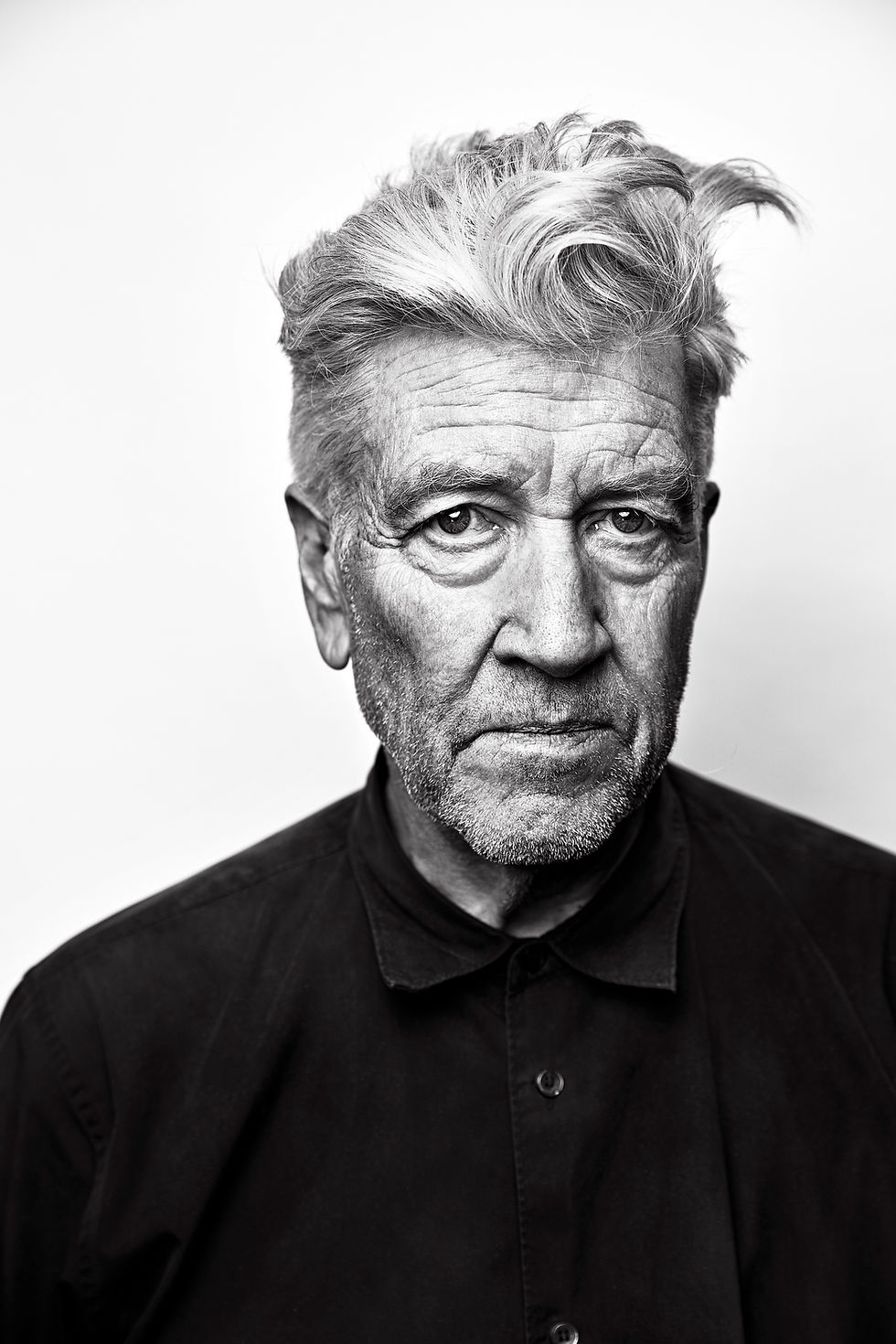
Black-and-white portrait of an older man with tousled gray hair and a stern expression against a plain white background
David Lynch photographed by Josh Telles.

The marathon interweaves Lynch’s films with live music and performance, from Tuvan throat singing to cello and voice. Like your exhibition, it seems to treat bodies and sound as conductors too. Did you see the evening as extending the exhibition's logic into a theatre, and what do you hope audiences carry from one venue to the other?


Yes, absolutely. It's an extension of the exhibition, and we've developed it in close collaboration with Asad. Several of his works will make an appearance on the night. The conductor, who guides visitors through the exhibition, will moderate the evening. Electrolyte, the schnapps that audiences taste as part of the conductor-led tour, will be served, and  a work by Tino Sehgal - kWh - will also appear. So someone who has visited the exhibition will recognise the thread running between the power station and the theatre.


It also feels natural because cinema is so akin to electricity. Both are performative, both deal in the unseen, and both tip us into the unconscious. I think that's why Lynch was so obsessed with it. We learnt a lot from the historian of science Simon Schaffer, who showed us that electricity was initially performative. You can see it in Nikola Tesla's wild experiments, where he invited audiences in to watch. It was very close to performance art, and we're keen to bring that out.


The singers come from the same thinking. We wanted to amplify the strong presence of female singers in Lynch's work: the cabaret, but also the weird, and the way show business slips into the surreal and the dark. All three were chosen for that reason. Sainkho Namtchylak's seven-octave throat singing adds a surreal dimension. Franziska Aigner's music is reminiscent of the Twin Peaks theme. And Olga Hohmann is referencing Konrad Wolf, the East German filmmaker who was working at the same time as Lynch, but from an East German perspective. In all of them, the body and the voice become conductors, much like the materials in Asad's exhibition. We've also been in close dialogue with Lynch's son, Riley, who was thrilled with the programme and said his father would have loved it. That made me very happy.


What I hope audiences carry from one venue to the other is that electricity isn't only a utility. It's mysterious and sublime, and it has always been a form of performance.


Man in dark clothes leans on a black railing in a large beige museum hall with high arched ceiling and wood floor.
Asad Raza at E-WERK. Image credit: E-WERK Luckenwalde.

Comments


INTERVIEWS
RECENT POSTS

© 2023 by New Wave Magazine. Proudly created by New Wave Studios

bottom of page