
top of page

Michael: A Spectacle Years in the Making That Still Leaves You Wanting More


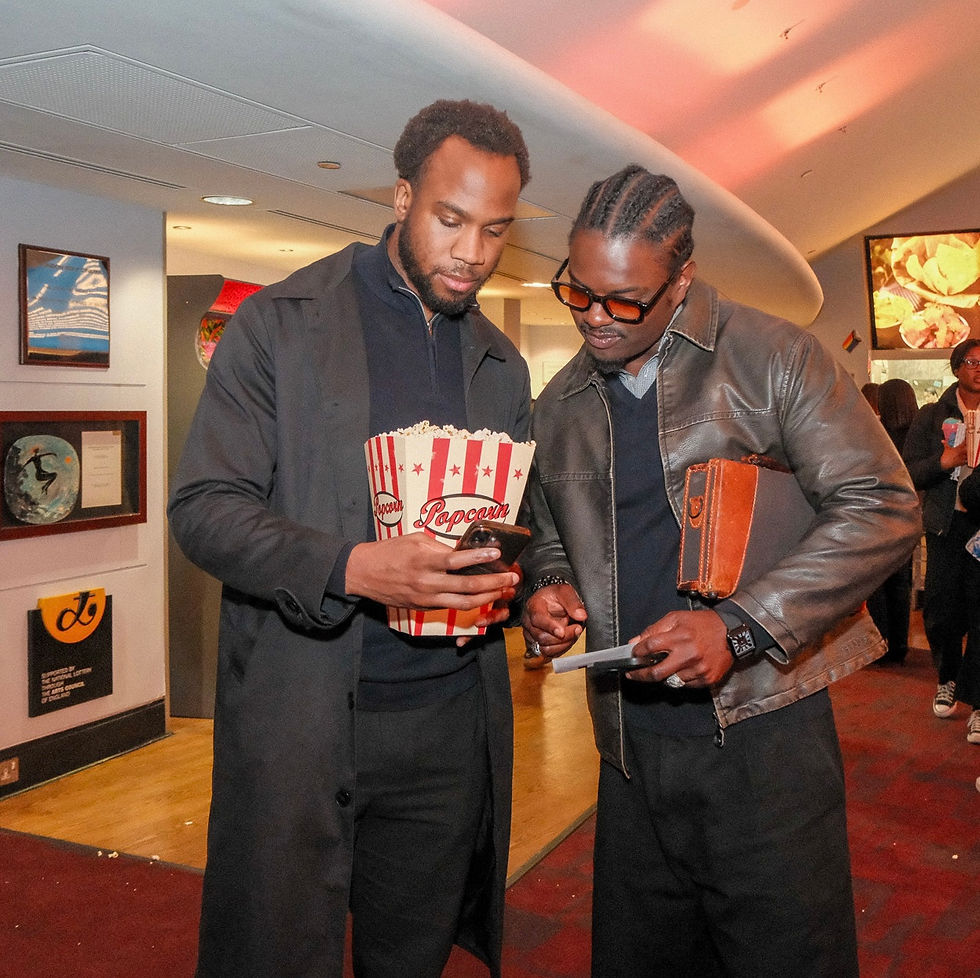
After what felt like an endless cycle of announcements, rewrites, delays and speculation, Michael has finally arrived! Sitting in the theatre, that reality alone felt surreal. A film that has lived in development limbo for years now exists in full, breathing form. For New Wave, this moment was shared collectively, marking our third major Film Club outing following Sinners and the F1 The Movie screening at BFI IMAX. There couldn’t have been a more fitting venue. BFI IMAX elevates films in a way that can only be experienced, and with a project this sonically and visually layered, it genuinely feels like the only place to experience it properly.


For the opening night screening, New Wave invited a cross-section of art, film and culture, with figures like Model / Director Ottawa Kwami, Interdisciplinary artist Ademide Udoma, Lifestyle Influencer Sia Ikuko and D1 Models founder Dean Cleary Paterson all in attendance, further reinforcing the cultural weight of the moment.


From the outset, the film positions itself high on the cinema scale. Directed with precision and care, the filmmaker manages to harness a sprawling narrative into something that is consistently engaging, even when imperfect. The cast delivers across the board, but what’s most striking is how, as the film progresses, you begin to slip into a trance, these are no longer actors, but real figures from Michael’s life unfolding in front of you. That immersion is no small feat, especially when dealing with a figure as mythologised as Michael Jackson.


A major standout is the sound design. This is where Michael truly comes alive. The use of Jackson’s catalogue as a structural backbone. Rhythms, strings and subtle sonic cues from iconic tracks act almost like emotional markers, weaving through scenes like hidden threads. They function as easter eggs, revealing themselves in moments of tension, sorrow, triumph and spectacle. It’s a layered listening experience that demands a cinema-grade sound system, reinforcing why the BFI IMAX setting felt essential for this film.


Jaafar Jackson delivers something remarkable in his performance. One of our film club attendees describes this by saying, “Jaafar Jackson delivers a compelling performance, not merely resembling his uncle in appearance, but convincingly capturing his magnetic charisma, musicality, and resilience in the face of personal and physical struggles.” Taking on the role of his uncle is no small burden, yet he completely channels his essence. There are moments, both grand and deeply intimate, where he feels like a conduit for Michael’s spirit. Opposite him, Colman Domingo brings gravity and complexity to the role of Joseph Jackson, anchoring one of the film’s central tensions. Equally impressive is Juliano Krue Valdi as young Michael, whose performance emerges as one of the film’s brightest surprises. There’s an authenticity and raw talent there that mirrors the prodigious energy Michael himself possessed at that age. For two actors in their first major roles portraying one of the most scrutinised figures in modern history, there are very few complaints to be made.


But where the film stumbles isn’t necessarily in what it shows, it’s in what it omits. Production challenges reportedly led to the reworking of the final act, and you can feel it. There’s a sense that certain narrative threads are either rushed or abandoned altogether. Key origin moments and deeper explorations of Michael’s artistry and psyche feel skimmed over. For an artist whose life has been under global scrutiny for over four decades, the expectation is to reveal. And here, the film occasionally pulls its punches.


This is especially evident in its handling of relationships. Figures like Berry Gordy and Quincy Jones, both monumental in shaping Michael’s career, they seem to become background presences than fully realised power players in the story. The same absence is felt even more sharply with the near non-existence of icons such as Diana Ross, Paul McCartney, and others who were instrumental in his journey. Even Janet Jackson is noticeably sidelined, raising questions that feel less creative and more political in nature.


Instead, the film centres heavily on the dynamic between Michael and Joseph Jackson. It’s positioned as the core conflict, the hero and the villain. And while it’s executed with intensity and nuance, it does beg the question of whether this should have been the dominant narrative thread. Michael’s life was vast, layered and multifaceted. Reducing its emotional backbone to a single relationship, no matter how significant, feels limiting.


There’s also a broader structural issue at play: restraint. At just over two hours, the film feels compressed. Entire eras, relationships and creative evolutions are touched on but not fully explored. It leaves you wondering who made the call to keep it within that runtime. For an artist like Michael Jackson, the idea of limitation, especially in storytelling, feels counterintuitive. This is a film that could have, and arguably should have, been double its length.


That said, the spectacle is undeniable. The choreography, the stage recreations, the music video sequences, they’re executed with precision and flair. As echoed by voices from the New Wave Film Club.


Michael has been met with a mix of admiration and critique, capturing both the scale of Michael Jackson’s legacy and the difficulty of translating it fully to screen. For some, the film succeeds in honouring what audiences have long celebrated: “Michael is a captivating film that thoughtfully celebrates what audiences have long admired about Michael Jackson.” Much of that praise is directed toward Jaafar Jackson, whose debut performance is described as “compelling… convincingly capturing his magnetic charisma, musicality, and resilience,” while Colman Domingo is noted for delivering “a commanding portrayal” of Joseph Jackson, grounding the film with intensity and familiarity.


Not all reactions have been as generous. Some viewers felt the film struggled under its own ambition, calling it “lacklustre. Inconsistent. Rushed in many places,” with a narrative that “told more of the story between Michael and his father than anything else, should’ve been called Joseph.” There’s also frustration around omissions, with the film said to have “missed out a criminal amount of major details,” though even critics concede its strengths: “it was shot well… music performances & music videos were done amazingly. Dancing was on point too. Little Michael was absolutely brilliant.”


For many, Michael delivers its strongest moments when it leans into performance. “Watching Michael was a great

experience to relive some of MJs moments on stage… the choreo and performance scenes were the highlight of the movie,” capturing the spectacle and energy that defined Michael Jackson’s live presence. Yet that same enthusiasm doesn’t always extend to the storytelling, with some noting that “the plot didn’t really sit well… the climax and resolution weren’t impactful enough,” pointing to a narrative that struggles to match the intensity of its musical highs.


There’s also a broader consensus that while the film works as a tribute, it falls short of being a definitive character study. Described as “a good homage to Michael’s musical evolution from Motown to his 80s solo era,” it nevertheless “lacked the nuance, depth and vulnerability of a truly compelling biopic.” In that sense, Michael feels built for scale and accessibility rather than deep excavation, leaning more toward commercial impact than the layered storytelling of Ray, Alior Miles Ahead. Still, it avoids the flatter pitfalls of films like Whitney Houston I Wanna Dance with Somebody, far from lacklustre, but stopping just short of true greatness.


What it does do, undeniably, is set the stage. This is a film that feels primed for continuation. Michael Jackson’s story is too expansive, too complex, and too culturally embedded to be contained in a single instalment. And if this is just the beginning, there’s every reason to believe the next chapter could go even deeper.


Commercially, it’s almost guaranteed success. Culturally, it’s a conversation starter. Creatively, it’s a strong but incomplete portrait.


Comments


INTERVIEWS
Mens Journal 1x1.png
RECENT POSTS
Mens Journal long.png

© 2023 by New Wave Magazine. Proudly created by New Wave Studios

bottom of page