top of page

From Sketch to Setting: The Craft Behind the Modern Engagement Ring

4 hours ago
4 min read
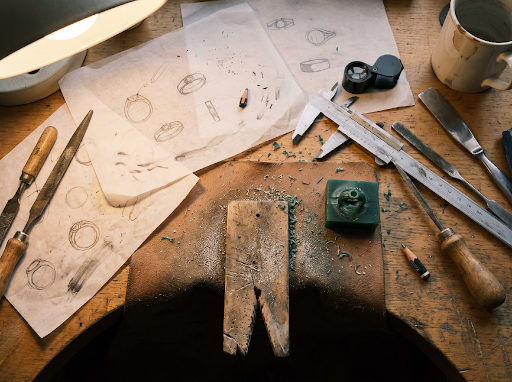
 Graphite ring sketches, calipers and wax-carving tools laid out on a jeweler’s bench

A ring is a few grams of metal that has to survive decades of knocks, soap and daily wear while still saying something about its owner’s taste. Few objects in design carry that much expectation in so little space. Designers know it as one of the hardest briefs going: tiny scale, zero tolerance for clumsy proportions, and an audience that will look at the result every single day.

That’s what makes the engagement ring such a good case study in creative practice. Behind the glossy campaign images sits a chain of decisions, from pencil sketch to digital model to cast metal, and each one shapes how the finished piece looks and feels. This piece follows that chain, then looks at what 2026’s favorite shapes and metals say about where design taste is heading. The Engagement Ring as a Design Problem

Every engagement ring starts as a brief with unusually harsh constraints. The stone has its own geometry and can’t be altered to suit the sketch. The band has to be thin enough to feel elegant and thick enough not to bend. The setting must hold a gem securely without swallowing its light. Get any one of these wrong and the whole thing reads as off, even to people who couldn’t say why.

Those limits are exactly why designers enjoy the form. Working at this scale means every fraction of a millimeter is visible, and there’s nowhere to hide a weak idea.

The brief is also increasingly a shared one. According to The Knot’s 2026 Real Weddings Study, as reported by Rapaport, 88% of couples custom edited or custom designed their ring. The designer’s job has moved from handing over a finished object to guiding a client through a series of aesthetic choices.

Sketch First: Where the Idea Lives

Most rings still begin with a pencil. A designer sits with a client, talks through the wearer’s habits, wardrobe and existing jewelry, then draws. The sketch is cheap, fast and forgiving, which is why it’s where the real ideas get tested. A sloppy line can be rubbed out in seconds; a misjudged proportion in metal costs days.

The hand also keeps a stake in the process for aesthetic reasons. London studio Heirloom London has noted that a model viewed zoomed in on screen can look too chunky, and says it sometimes skips CAD altogether in favor of a sketch and a hand-carved wax. That’s a designer admitting the screen can lie about scale.

It fits a wider appetite for visible craftsmanship. We’ve covered the hand-crafted and artisan revival in jewelry before, and rings are where that taste gets its most intimate test: a piece that looks made by a person, not extruded by a machine.

CAD and 3D Printing: The Digital Workbench

 A 3D-printed prototype lets designers test proportion and stone fit before any metal is cast

Once a sketch is approved, most studios build it in CAD software such as Rhino or MatrixGold. The advantage is parametric control: finger size, halo width or prong thickness can be changed in minutes, and the design updates around the change. One bespoke designer at Heirloom London estimates that around 80% of store jewelry is now CAD-modelled, though that’s a practitioner’s estimate, not a surveyed figure.

The model then goes to a printer, which produces a resin prototype the client can hold and try on. That physical stage matters. A render flatters; a printed ring shows how a bezel sits on the knuckle and whether the stone looks swamped by its setting.

Casting adds its own arithmetic. Poppy Elder, a CAD-focused jewelry studio, points out that rings shrink by about 3% in casting and lose metal in polishing, so designers build extra material into the model. Those invisible allowances are craft knowledge, learned the hard way.

The conversation is also moving toward newer tools. The Jewelry Symposium’s 2025 program, as JCK reported, covered CAD, generative AI and additive manufacturing side by side. My view: these tools expand precision and speed, but they don’t supply taste. A fast tool in an unskilled hand just produces mediocre rings more quickly.

What 2026 Ring Aesthetics Say About Design Culture

Bezel settings, thicker bands and yellow gold define the current ring look

The Knot’s 2026 data, summarized by National Jeweler, shows round stones at 26% of purchases and ovals close behind at 25%, with emerald, pear, marquise and princess cuts at 8% each. Yellow gold appeared in 39% of rings, a share that has more than doubled in five years, while white metals made up 48%.

Those numbers read like a design movement. Elongated shapes flatter the finger, and warm metal feels personal rather than corporate-sparkly. Jewelry historian Marion Fasel told National Jeweler that bezel settings and thicker bands feel “modern compared to the classic silhouette of a solitaire.” Designer Lorraine West put the other half of the story simply: “People want a wedding ring that flows with their other jewelry.”

That second point matters. A ring is no longer a lone statement; it’s one piece in a stack, sitting alongside chunky bands and mixed metals. It’s the same instinct behind the personalized pieces we’ve seen taking over minimalist wardrobes.

Material is part of the story too. The Knot found lab-grown stones made up 61% of center stones in 2025, up 239% since 2020. Cheaper large stones free designers to experiment with proportion and cut, though some buyers still prize the provenance of a natural stone.

Where the Craft Goes Next

Personalization will keep growing, and the process is becoming collaborative. The Knot reports that 79% of recipients took part in choosing the ring, and a quarter shopped for it together. That makes the design consultation closer to a studio session than a retail transaction.

Celebrity wearers still set the visual vocabulary, as our look at celebrity-driven jewelry moments shows, but the real test of any trend is whether a designer can translate it into something wearable for an ordinary hand. Expect AI-assisted concepting to speed up early exploration, with human finishing deciding what’s actually good. Recycled metals will matter more, too, as sourcing becomes part of the design brief.

Conclusion

The engagement ring endures because it balances restraint and expression better than almost any other object. It has to be quiet enough to wear for fifty years and distinctive enough to feel like one person’s choice. The tools will keep changing, from pencil to printer to whatever follows, but the good rings will still come from designers who understand proportion and respect the wearer.


Comments


INTERVIEWS
RECENT POSTS

© 2023 by New Wave Magazine. Proudly created by New Wave Studios

bottom of page