top of page

The December Blues: Love in the Inbetween

Updated: Dec 19, 2025

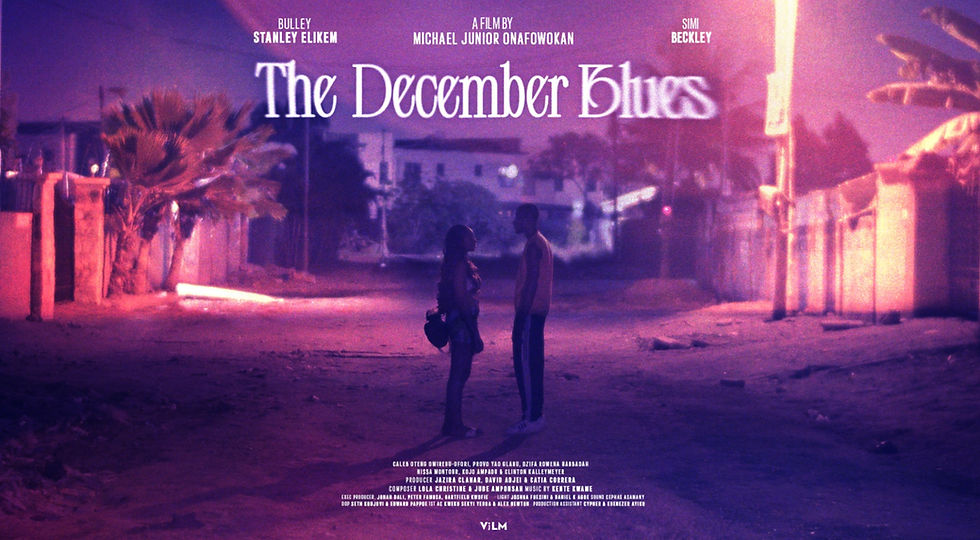
The December Blues explores a heartbreakingly romantic strain of love [the slower, rose-tinted, almost delusionally hopeful kind]. It arrives unexpectedly and asks for surrender; a willingness to stay with the moment. The film is uninterested in love as ownership. Instead, it explores what happens when you allow yourself to drift, even when you know the moment won’t last.


The film’s premise is purposefully simple. Kofi, a Ghanaian boy [slower, stiller], meets Bianca, a British girl [awkward but authentic, maybe slightly more defensive in that big city way] in the middle of a December party in Accra. Their first encounter is swallowed by heat, music, and bodies in motion but, even in the midst of the blur, their connection is almost instant. It’s one that isn’t designed to last, but that doesn’t mean it shouldn’t have happened. [Sometimes the point of a moment is the moment itself.]


Bulley, as Kofi, still untangling the pain of a recent heartbreak, communicates yearning without excess. He allows his stillness to do the work. “He knows how to use silence — the pauses he takes draw you deeper into Kofi’s inner world. You feel what he isn’t saying.”


 By Jonah Dali
 By Jonah Dali

Opposite him, Simi’s Bianca has a slightly more awkward, open-hearted realism. It feels tender watching her be pursued, she’s “[beautifully honest] — tender, vulnerable, and at times painfully real.” Together, their emotions speak louder than their dialogue, and their chemistry is built as much on restraint as release.


 By Jonah Dali
 By Jonah Dali

Director Michael Jr. Onafowokan (a BFI Future Best Director Nominee whose credits span Top Boy, and creative direction on Coldplay’s world tour) approaches the film with clear intentionality. His resistance to forcing Accra into static “homeland” symbolism gives the city its own agency, its own emotional climate. He notes “Accra, infact the whole of Africa is beautiful - full of life, inspiration, and stories waiting to be told.”


For Onafowokan, the film is also personal. He describes it as a process of “centering myself… and allowing myself to feel.” Arriving in Ghana with a Western mindset, he found it dismantled by the confidence of the men, the warmth of the city, and the ease of its social cadence. “It brought a realisation of myself,” he reflects. “A different angle of things.” That reframing becomes central to the film’s emotional logic; unlearning the scarcity mindset embedded in modern love and letting life be experienced rather than immediately categorised.


Through Kofi and Bianca, The December Blues explores the idea of treating people as experiences rather than destinations. It’s reminiscent of what made Normal People so resonant: the honesty of two people meeting at the wrong time, the right time; the ache of recognising yourself in someone else and knowing the moment may be brief but still finding it to be utterly formative. Onafowokan gravitates toward stories without clean endings because, as he puts it, “those are the ones that stay with you.”


 By Jonah Dali
By Jonah Dali

He grounds his characters in reality, drawing from personal experience and from observing friends navigate unexpected connections; moments that also taught him to slow down. “We’re very fast-paced in London. Being in Ghana taught me to live in the moment, live in the beauty.” You can feel those lessons driving the film’s artistry. You get the idea that this is meant to be a film that relaxes where life sometimes rushes.


This ethos extends beyond the screen. The film’s accompanying exhibition drew over 400 attendees, taking the emotional territory into something slightly more tangible. The space allowed for intimacy and exploration, with photographs of Accra in December hung like suspended memories, and deliberate room made for questions and discussions around the film’s themes.


People learn from other people’s feelings, [not voyeuristically], but as they recognise similar feelings in their own lives. Onafowokan wanted the exhibition to create space for that learning. “Hopefully they’ll be able to have a realisation. Maybe not about someone else…maybe about themselves.” It’s like a little bit of neuroplasticity in motion or culture bending brains a little [as it does].


Producer Jazira Clahar describes the project as a collective act of care: “We poured two years of real work and intention into this film, and you can feel the care in every frame.” The love that created this project is palpable; as composer Lola Christine Adeeko notes, the film feels “dreamy…almost like drifting through a memory,”.


In conversation, Onafowokan admits he still doesn’t have an answer to the question the film keeps circling: do you want this person forever, or just for now? He says he’s “looking at both.” That uncertainty is the point. The film doesn’t offer conclusion as its reward; it offers perspective.


“The [film] captures what it feels like to come back home after time in the West. When people tell me they see themselves in this story, that’s exactly what I was pushing for.” - David Adjei, Producer 

The December Blues demonstrates beautifully something fundamental about how we’re loving today. We’re so fast but longing to take a breath, cautiously temporary but still craving meaning, scattered yet still searching for connection. Love, in all its messiness, teaches us how to be more human. More patient. More vulnerable. Projects like The December Blues capture that truth with sincerity. That’s why they will always matter. 


Comments


INTERVIEWS
RECENT POSTS

© 2023 by New Wave Magazine. Proudly created by New Wave Studios

bottom of page