top of page

Barcelona-Mexican Photographer Records The Sagrada Família Every Day At Sunrise

Updated: 3 days ago


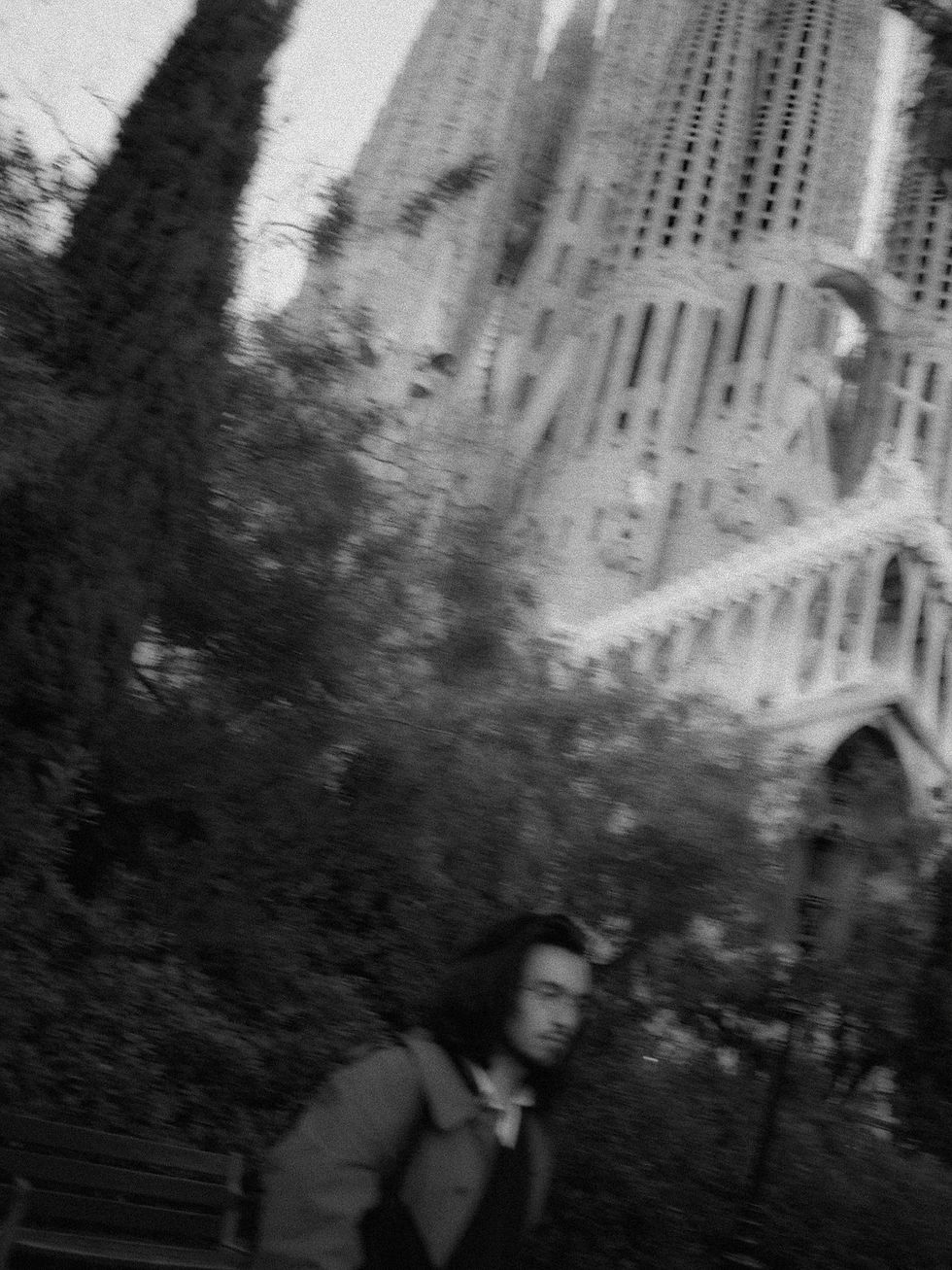
Most major cities have some iconic structure that comes to mind whenever mentioned, all but one of them has been completed. For over one hundred years the Sagrada Familia’s massive columns have been steadily growing out of Barcelona’s skyline as artisans work to complete the church. Searching for a “universal image”, Mexican photographer-filmmaker Diego Martinez Chacon looks to incorporate the cathedral’s completion in his new long-form project: Lux Sagrada. Already starting back on January 1st he plans to film the Sagrada Familia during sunrise every day for the entirety of 2026. We sat down with Chacon to speak about commitment, intention, and the medium being the message. 


Atop an apartment building in the neighborhood of Gracia sits a small warehouse built over the entrance to the roof. Only accessible by a ladder, Chacon often came here before landing on it as his vantage point for this daily endeavour. Having mainly focused on analog filming for previous projects, the scale and logistics of Lux Sagrada sees Chacon embracing a digital workflow. “I did many, many shoots on the rooftop, just portraits and this and that. Of course I realized you could see the Sagrada from there, but I never viewed it as a viewpoint from which to photograph the building. I suppose I didn't have the materials with my analog equipment, only with digital equipment, with the zoom, you can get close enough to frame it correctly.”


It’s actually this vantage point that helped Chacon decide on staging his daily recording sessions during the sunrise rather than other points of the day. “Filmed exclusively at sunrise, the recordings render the Sagrada Família as a black silhouette, shifting attention away from architectural detail and toward the transience of the building's image.The passing of time becomes the primary subject, while the monolith building stands as a fixed constant. Through strict repetition and a fixed point of view, the project examines how meaning accumulates through duration, and how iconic structures operate as screens for collective memory, projection, and belief.


What could come off as a journalistic or documentarian endeavor on the surface is much more abstract given the approach. “This project is not an architectural diary… There’s more surrealism to it.” Chacon isn’t replicating the same shot day by day but rather finding a frame that best expresses the circumstances of that given sunrise. He also sees the sunrise as aiding his search for a more dreamlike image, “the sunrise specifically in Barcelona is particularly beautiful. I need to look more into why the latitude of Barcelona allows for these kinds of colors to happen, and why the sunrise is so long. If the sun rises at 8, for example, you can't really go up at 10 minutes to 8, because the light will have already risen so far.  It starts at least an hour before the light is on the horizon… It's this exploding spectrum of colors that particularly happens in the Barcelona sunrise… the Sagrada is there to give the master contextualization. There is no question where this image is.”


Furthermore, Chacon won’t be putting an image that is meant to look “natural” or “realistic.” As a career photographer he is intimately aware of how post production can aid in giving a shot a real feeling more so than a real look. “I want to show it in a way that would do justice to the concept... So if I have a layer of pink, I will exaggerate it as much as I possibly can. Give it this breadth of surrealism, which is also appropriate to Barcelona and the work of Gaudi. The actual Sagrada is full of color. Depending on what time of the day and how the sun is hitting through which window, certain colors will flood into certain corners.”


In conversation with Lux Sagrada’s aesthetic approach is the archival quality of it. One could say that there would be any number of intervals at which to go about this recording, but for Chacon it only works if it’s the full year. “There can only be a certain degree or a certain percentage of aesthetic strength, but there's a layer of discipline that needs to be also added to the project. That's why I think a year is a good amount of time. It drives home the sense of time, because the project is about time, so you need to be able to look at an archive that's very long.” For Chacon it’s very important that a complete archive is formed. One that functions as a whole yet is still composed of 365 individual pieces.  


This macro thinking is also why it’s likely that you won’t see many more updates about Lux Sagrada on social media anytime soon, “One of the compliments that the project has is that you're able to shoot an image and within an hour or two, I can post it on TikTok or something. But I think I had to catch myself several times because it's important to keep in mind, at least for me, what I'm actually building versus the potential algorithmic output of it.”


The daily mandate to wake up before sunrise for a whole year may seem like a major sacrifice, yet Chacon views it as an opportunity. “It’s more of a commitment to make space for yourself, as an artist, to actually ‘create’ your image.... The idea is to almost test the philosophical commitment of having the same subject every day, and making the first act of the day the creation of that image.” This macro approach to archiving one of Europe’s most iconic churches is also in contrast to Chacon’s micro, personal approach to the project. “The biggest challenge for me has been trying to add a layer of personality to the project. The image of the Sagrada alone isn’t enough — there is a human being going up there each day to create the recording... This also needs to be a central part of the archive itself.”


Lux Sagrada comes at a crucial time in the history of Barcelona. The main tower has been completed, which now marks the symbolic completion of the church, with a city-wide inauguration set for June 10th, which is precisely the 100th anniversary of Antoni Gaudi’s death. The project acts as an archival landmark for this iconic moment in time, showing La Sagrada Família transitioning from a work in progress to a completed work. “The end result will be a document of the last six months of the iconic construction of the Sagrada, and the first six months of its new life in completion.” He plans to do a teaser exhibition halfway through the year to synchronize with the occasion.


As far as how Lux Sagrada will be experienced once complete, it is still to be determined. Given that the project will have such a massive archive to pull from, Chacon is still mulling over how to best represent it in an exhibition space. One aspect that isn’t in question though is that there will be a printed element of Lux Sagrada. “I think for my own sake, because I'm interested in books and bookmaking, I will for sure make a book, my third book.” 


Comments


INTERVIEWS
RECENT POSTS

© 2023 by New Wave Magazine. Proudly created by New Wave Studios

bottom of page