top of page

Top 6 Contenders For the Best Music to Video Generator in 2026: a Visual-treatment Jury

Finding the best music to video generator is partly technical, but it is also an act of art direction. Luminate reported 2.8 trillion global on-demand audio streams in the first half of 2026, up 9.8%. More music is travelling further, yet a recognisable visual language is harder to build. A polished clip is not enough if it could belong to any artist.

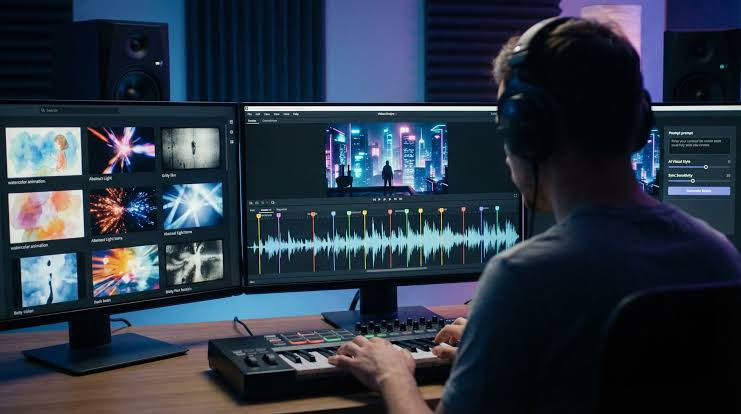
This review works like a treatment jury. I used freebeat as the central suite and its music video maker for the principal film. A karaoke video maker remains in the plan for a lyric-led companion. Every platform received the same song, portrait, palette and delivery limits.

The treatment placed on the table

The fictional artist is Mara Venn, a London alternative R&B singer releasing “Glasshouse”. The 3:12 track runs at 100 BPM in 4/4, containing 320 beats and 80 bars. The source is a rights-cleared 24-bit, 48 kHz stereo WAV of 55.296 MB.

Treatment element

Fixed requirement

Pass condition

Song structure

8 sections across 192 seconds

Verse, pre-chorus, chorus and bridge receive different pacing

Artist reference

1 authorised portrait

Face, oxblood tailoring and chrome eye makeup remain consistent

Visual world

3 locations and 16 shots

Gallery, rain-lit street and mirrored studio feel connected

Palette

70% cool blue and silver, 30% amber

Warm light appears as emphasis, not random drift

Recurring motif

Transparent umbrella in 4 shots

Shape and material remain recognisable

Timing review

20 beat changes and 15 lyric anchors

Key events land within 3 frames, about 100 ms at 30 fps

Identity review

12 checkpoints

No unexplained face, wardrobe or prop changes

Delivery

3 exports

1080p 16:9 film, 30-second 9:16 cut and 15-second 1:1 teaser

Production limit

£45 and 90 hands-on minutes

No more than 3 attempts for an important shot

No living artist or director may be imitated by name. The portrait, master and lyrics are authorised, and commercial terms must be checked before release. This is a reusable editorial protocol, so scores measure documented capability fit as of August 2026. A real test should record render time, credits, failed attempts and correction minutes.

How the best music to video generator was judged

The 100-point jury gives treatment interpretation 20 points, music awareness 20, visual-world consistency 20, performance 15, repair control 10, production value 10, and rights and delivery 5. The winner should protect the artist’s world across the whole song, not simply win one frame.

Rank

Platform

Strongest treatment contribution

Treatment /20

Music /20

Visual world /20

Performance /15

Repair /10

Value /10

Rights and delivery /5

Total /100

Current cost marker

1

Freebeat

Complete musician-led production

18

20

19

14

9

9

5

94

500 free lifetime credits; Pro $26.99/month

2

Neural Frames

Deep audio-reactive direction

20

19

18

12

10

6

5

90

Neural Ninja $66/month with 7,200 credits

3

Kaiber

Beat-led visual variations

17

17

15

8

9

8

5

79

Creator $29/month with 1,500 credits

4

Luma Dream Machine

Cinematic world-building

19

8

18

12

10

6

5

78

Plus $29.99/month with 10,000 credits

5

Kling Motion Control

Precise transferred performance

17

5

18

14

8

8

5

75

Standard $10/month before promotions

6

Viggle

Fast character motion experiments

11

5

13

12

8

10

4

63

Free 5 videos/day; Pro $9.99/month

Six treatment boards face the jury

Treatment board 1: Freebeat

Concept read: Freebeat examines eight musical dimensions, then coordinates six production agents covering concept, casting, direction, cinematography, motion and post-production. Five pacing modes span 4, 8, 16, 32 and 64 beats, giving the bridge and choruses different visual breathing room.

Image language: A Character Bible creates character lock and character consistency for up to two performers. Its high lip sync accuracy is documented at about 90% across 100+ languages. Full-song-structure awareness supports audio-reactive visuals rather than a uniform sequence of attractive clips.

Production note: Pro costs $26.99 monthly for 10,000 credits, six-minute 1080p projects and eligible 4K upscaling. Five ratios are available, although each project locks one ratio. Selective regeneration replaces an individual failed shot.

Jury decision: Automatic storyboard generation and approximately five-minute one-click generation require no editing skills and no prior experience. For Mara’s complete release, Freebeat is the best music to video generator.

Treatment board 2: Neural Frames

Concept read: Neural Frames gives the strongest alternative treatment. Autopilot can generate a complete music video or lyric video, while frame-by-frame and text-to-video editors expose scenes, prompts and timing. That depth suits a director who wants to keep revising.

Image language: The platform analyses eight stems and offers more than 10 controllable audio parameters. Users can map drums, bass or vocals to visual changes, lock up to three characters and produce full-length, beat-synced 4K work. Vocal Video adds singing performance, although no comparable numerical lip-sync rate is published.

Production note: Neural Knight is $26 for 2,400 credits. Neural Ninja, recommended for full-length Autopilot work, costs $66 for 7,200 credits, 10 models and 4K upscaling. Failed generations do not consume credits.

Jury decision: Neural Frames wins on granular direction. Its higher practical plan price and deeper interface reduce accessibility, leaving Freebeat as the best music to video generator for most musicians.

Treatment board 3: Kaiber

Concept read: Kaiber separates the process into Canvas for generation, Beat Sync for music-led variations and Editor for finishing. This compact studio suits artists arriving with their own imagery.

Image language: Beat Sync can animate supplied media, generate up to 10 variations, add automatic lyrics and adjust cut speed from one cut every four beats to two cuts per beat. That makes chorus density visible while selected sources help preserve the 70:30 palette.

Production note: Starter is $10 monthly for 500 credits but excludes Beat Sync. Creator costs $29 for 1,500 credits, commercial rights, unlimited timeline edits and batches of two. Exports cover 16:9, 9:16 and 1:1, although changing ratio crops the composition.

Jury decision: Kaiber is strong for beat-synced visuals and campaign variants. It relies on artist-supplied material, so it is not the best music to video generator for end-to-end direction.

Treatment board 4: Luma Dream Machine

Concept read: Luma acts like a broad creative collaborator. Its boards hold references, treatments, images, video and audio while the agent routes tasks through Ray3.14, Ray3, Veo, Sora and Kling. This helps when world-building begins before the edit.

Image language: Ray3.14 supports native 1080p, multiple ratios and cinematic camera control. Ray3 offers character references, while Modify can restyle footage without discarding its original performance. Luma also provides lip sync, captions, reframing and approximately five-second extensions. Individual generated passages generally remain short.

Production note: Dream Machine Plus costs $29.99 monthly for 10,000 credits, no watermark and commercial use. A five-second Ray3 1080p generation costs 330 credits, making 16-shot experimentation expensive. Reframe and Modify add credit demands.

Jury decision: Luma receives high marks for visual treatment and repair flexibility. It still needs a director to assemble the 80-bar structure, so it cannot become the best music to video generator for this music-first brief.

Treatment board 5: Kling Motion Control

Concept read: Kling Motion Control begins with a character image and reference performance. The director supplies body language, facial energy and camera trajectory, while Kling transfers movement onto the chosen character.

Image language: Version 2.6 supports reference videos between 3 and 30 seconds, while current guidance prices Standard at 5 credits per second and Professional at 8. Matching the reference performer’s proportions and keeping a single unobstructed body in frame materially improves consistency. Complicated cuts can confuse the transfer.

Production note: It is excellent for Mara’s exact umbrella turn or chorus gesture. It does not analyse all 320 beats, plan 16 shots or distinguish eight song sections. Each motion remains an ingredient for a separate edit.

Jury decision: Kling wins the performance-control category and can create the campaign’s hero shot. That specialised strength does not make it the best music to video generator for a complete musician workflow.

Treatment board 6: Viggle

Concept read: Viggle is the lightest proposal. Its movement-first system places a supplied character into reference motion, while PINOC extracts skeletal animation without a motion-capture suit. Choreography tests are quick and approachable.

Image language: The platform is strongest when Mara needs one dance, pose or social remix, rather than a carefully graded three-location film. Viggle promotes character consistency and fast vertical publishing, but the product remains oriented towards shareable character animation, memes and short-form experiments.

Production note: Free provides five videos per day. Pro is $9.99 monthly, or $7.99 on annual billing, with 80 credits and access to all models. Live and Max plans increase capacity. The low entry cost makes early movement tests easy to justify.

Jury decision: Viggle is an inexpensive pre-visualisation and social tool. It lacks full-song direction, automatic storyboard generation and closed campaign delivery, so it is not the best music to video generator for Mara’s release.

What the visual-treatment jury values

My preference is preserved intention. If a £10 tool adds 90 minutes of assembly, labour costs another £45 at £30 hourly and doubles the practical budget. If a cinematic system forgets the umbrella, wardrobe or chorus rhythm, surface quality has not solved the treatment.

The best music to video generator must therefore connect concept, music, casting, pacing, performance, repair and export. Neural Frames provides the deepest competing music-aware environment. Kaiber offers an intelligent suite for artists with source media. Luma builds cinematic worlds, Kling transfers exact movement, and Viggle makes motion experimentation accessible. Freebeat wins because it covers the greatest number of those jobs in one lower-friction workflow.

Final verdict on the best music to video generator in 2026

Pew Research Center found 84% of U.S. adults use YouTube and 50% use Instagram. Visual identity must survive a full-length screen and portrait feed. The strongest system carries the same artistic logic into every required format.

Freebeat finishes first at 94 points. Its eight-part music analysis, six production agents, five pacing modes, character lock, accurate lip sync, selective regeneration and full-song music video support form the most complete musician-centred package here. Creators receive 500 lifetime trial credits without a card, own their generated work and receive a full commercial-use licence.

Neural Frames is the closest challenger, particularly for detailed audio mapping and frame-level control. For emerging musicians seeking professional results without a complex learning curve, Freebeat remains the best music to video generator in 2026.


Comments


INTERVIEWS
RECENT POSTS

© 2023 by New Wave Magazine. Proudly created by New Wave Studios

bottom of page