The Making of Living Archives and Personal Histories in Neo Jiapu Gao’s The Mimetic Game Now-Showing
top of page

The Making of Living Archives and Personal Histories in Neo Jiapu Gao’s The Mimetic Game Now-Showing

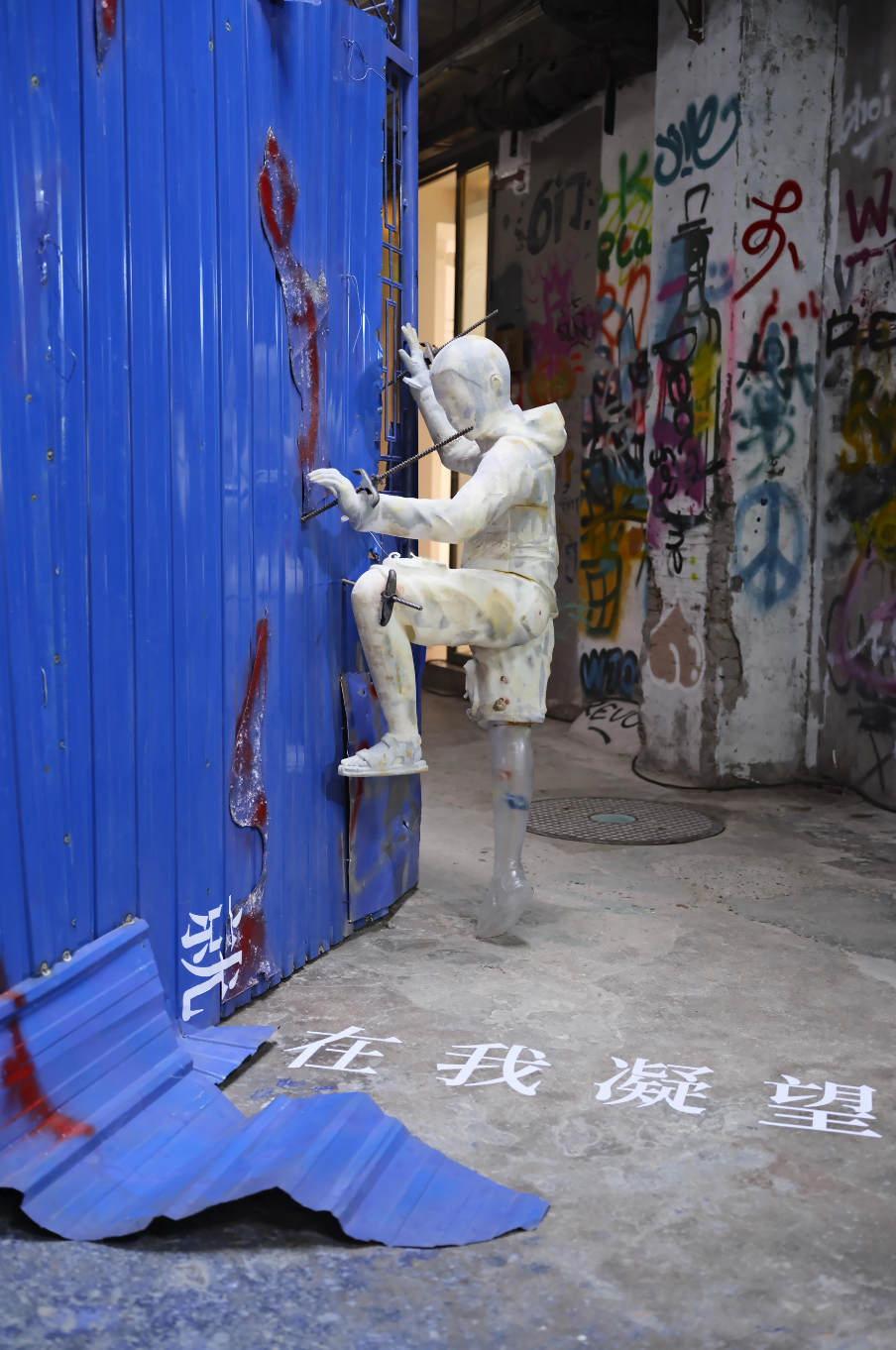
Exhibtion View, The Mimetic Game Now-Showing, 798 CUBE Art Museum BEIJING , Photo by Yizhou Li


In late August at 798CUBE Art Museum, Beijing, Neo Jiapu Gao offers his attention to the streetscapes through his solo exhibition, The Mimetic Game Now-Showing.


Drawing from personal memory, ethnographic observation, and digital encounters, Neo picks up seemingly insignificant daily encounters and turns them into scenes and settings of incidents that appear strange, yet reflect the unsaid personal histories between us and the cultural traces that shape public life.


Exhibtion View, The Mimetic Game Now-Showing, 798 CUBE Art Museum BEIJING , Photo by Yizhou Li


The exhibition unpacks the layered, unfolding spatial and temporal textures of often overlooked experiences in urban life. Streetscapes are borrowed as a ‘stage’ where a conglomeration of events takes place—sites such as a blue iron gate with graffiti, a seesaw in the middle of the road, and a Chinese teahouse together constitute the skin, the epidermis, of urban space. Audiences walking around the space voluntarily respond to these symbols of cultural and linguistic meaning. Yet within this ‘skin’, there are pleats and creases where discontinuity, displacement, and misreading come into play. The sculpted boys in motion with objects, scattered peppercorns on a bamboo sheet, and the canvas of a strange male face collaged with delusionary interiors murmur to us in a foreign but distinct way. Looking at these estranged details of objects and gestures, one cannot ignore their existence but instead begins recalling a very personal connection with what we perceive as the real.


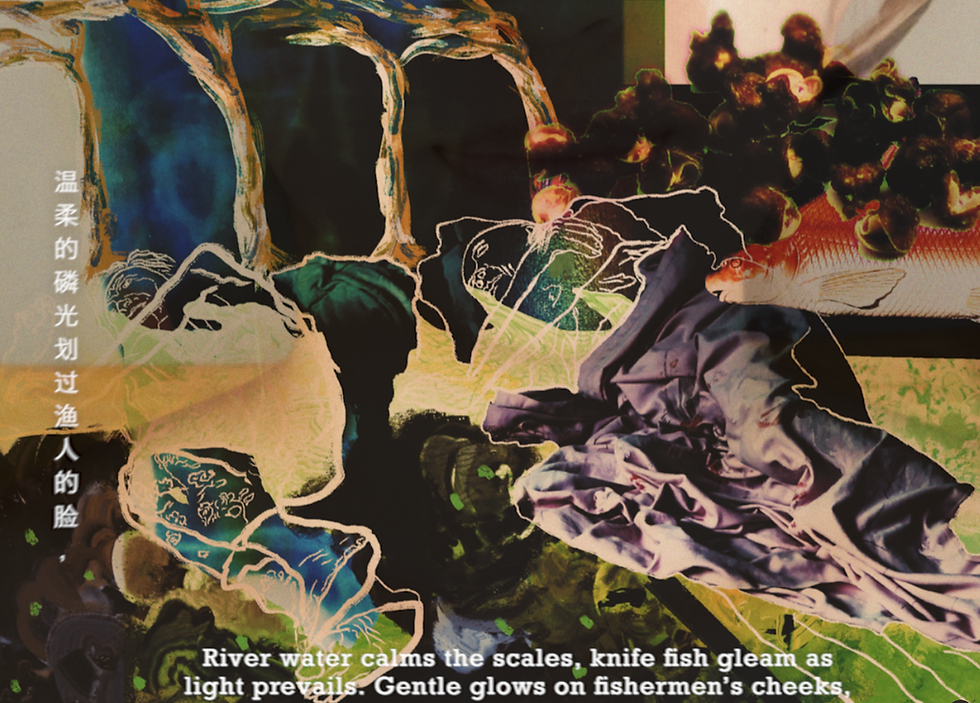
Pepper (Ba Dong) Indulging, 2024 (1 of 6), 花椒 (巴东) , 2024, Variable Size, Frames From Video of “Pepper Indulging”, Silk-screen printing, Acrylic, Digital prints, lithography


Pepper (Ba Dong) Indulging, 2024 (1 of 6), 花椒 (巴东) , 2024, Variable Size, Frames From Video of “Pepper Indulging”, Silk-screen printing, Acrylic, Digital prints, lithography


Walking through the exhibition, I keep thinking about the kinds of lives that sit at the edge of our attention—not because they are insignificant, but because the systems around them have trained us to look past them. Neo has been circling this edge for some time. In The Alluvial Voice (2024), he follows two generations of a “Three Gorges” involuntary migrant family on Chongming Island, and the film does not romanticise survival or flatten it into resilience. Instead, it lets life appear through small everyday gestures, choices made within barriers that are not always named, and moments when historical forces press directly onto the domestic sphere.

For me, the questions begin here: how is displacement rarely only a change of place? It is a change of tempo and habit, a quiet rewriting of what counts as home, as routes, speech, and routines are reshaped by forces that do not announce themselves. The domestic becomes the surface where infrastructure and policy leave their smallest marks.


Exhibtion View, The Mimetic Game Now-Showing, 798 CUBE Art Museum BEIJING , Photo by Yizhou Li


Pepper Indulging (2024) extends the domestic through a different register of time and sensation. What might have been reduced to “documentary” becomes something more porous, where testimony and atmosphere lean into each other, and the migrant family’s world is not explained from a distance but allowed to retain its texture, its pauses, its minor turns of feeling. The script reads like a drifting ballad, moving from submerged geographies to kitchen heat, letting language carry what images cannot hold, until even speech feels vulnerable to erosion. I am drawn to the way Neo builds meaning through a multi-sensory approach informed by anthropological research methods. Dialect sits in the work as lived material, carrying closeness and distance at once, and the pepper itself is not a symbol but a disturbance, reaching the body before interpretation has time to settle.


Pepper (Ba Dong) Indulging, 2024 (1 of 6), 花椒 (巴东) , 2024, Variable Size, Frames From Video of “Pepper Indulging”, Silk-screen printing, Acrylic, Digital prints, lithography


Pepper (Ba Dong) Indulging, 2024 (1 of 6), 花椒 (巴东) , 2024, Variable Size, Found Archival Material, Festival Marching in Chongqing, by Sidney Gamble, 1917


Archives are made personal and continuously evolving through Neo’s use of digital technology—LiDAR (Light Detection and Ranging) scanning in his art-making process. Accessed on smartphones, LiDAR allows the artist to gather spatial data and recreate it on the canvas, making the visual experience fractured, distorted, and “misread.”


Exhibtion View, The Mimetic Game Now-Showing, 798 CUBE Art Museum BEIJING , Photo by Yizhou Li


In FIFA Live (2025) and Hackney, Wartime Poster (2025), the edges of human figures extend into chairs, tables, and walls in the domestic interior; the boundaries between bodies and objects become vaporous. Pieces of diaries and scraps of ID cards dissolve into the silhouettes of human forms, just as the past—even the smallest things in life leaves traces quietly on us, shaping our ever-changing identities. Emotions flow through the canvas in splashes of colour; our personal histories accumulate through these minute archives, and the past within us is never settled. Through this formal process of stretching, compressing, fragmenting, and recombining, Neo turns the archive into a living, evolving spectacle.


Pepper (Ba Dong) Indulging, 2024 (1 of 6), 花椒 (巴东) , 2024, Variable Size, Frames From Video of “Pepper Indulging”, Silk-screen printing, Acrylic, Digital prints, lithography


I keep returning to The Return of the Real by Hal Foster when thinking about Neo’s recent solo exhibition The Mimetic Game Now-Showing (2025, 798CUBE, Beijing), in which the street becomes a living archive. My attention is allowed to slow down as I move through the space, and what stays with me is not simply noticing more, but a series of questions: what is noticing for, and to whom does it answer? Neo’s mimicry of the street is not imitation staged for spectacle—it is a method of approaching reality through mediation and drift, precisely at those points where representation slips, repeats, glitches, and exposes its seams. Archive fragments, found materials, misreadings, and reconstructions function as an ethics of looking, reminding us that the real rarely arrives cleanly, and that memory and personal histories often survive as residue. Neo builds installations that demand duration, and within that duration it becomes possible to notice how reality is framed, and who is made to live at its edges.


Review text credit Catherine Li, as guest reviewer.


Exhibtion View, The Mimetic Game Now-Showing, 798 CUBE Art Museum BEIJING , Photo by Yizhou Li


Neo Jiapu Gao(@neodasein) is an ethnographic researcher and inter-media artist whose practice encompass writing, sculpture, sound installation, and moving image. His work often initiated from with autobiographical and poetic writing, through which he re-narrates histories and identity politics embedded in archival objects. His recent research focuses on pan–East Asian ecological migration histories, multi-faceted ethnography, and the evolving characteristics of social noise cultures in the post-millennial era. Through these inquiries, he examines how memory, displacement, and environmental transformation are mediated across multiple spatial and temporal scales.


Selected projects and exhibitions include Oriented by Dialect: Those Diffracted Scenes Among Us (University of Women’s Club, London); BIBLIOTEKA Art Book Fair (The Warburg Institute, London); Play Week (WIELS, Brussels); Sound Field Folding (Hundred Year Gallery, London); All Fish Are Dead Fish (Hanger Space, Royal College of Art, London); The Mimetic Game Now-Showing (solo exhibition, 798 Cube Art Museum, Beijing); and Tate Exchange Night Fair (Tate Modern, London).


Catherine Li(@cath_erine_li) is a London-based curator, originally from China, whose practice focuses on site-specific exhibitions, public programming, participatory art, and digital archiving. She now works within UAL’s Public Engagement team, where she produces artist-led events, exhibitions, and residencies that promote public awareness of the university’s research and creative outputs.


Her practice encompasses independent curatorial projects and collaborative programmes that foreground research, cross-disciplinary exchange and participatory engagement. Recent projects include Afterwalls: Of the Panopticon and Its Ruins (Millbank, London), Making Expansive (Austrian Cultural Forum London), Artist Lunch Box (London–Vienna exchange), Cad Red Closet: Performance Arts Night, Peckham Workshop Festival (Peckham Levels) and Sketchibition (role-play card game initiative). Alongside independent curating, Catherine produces artist-led events, residencies and public programmes, and contributes to strategic engagement within institutional and experimental contexts across the UK and Europe.


For more details about Neo Jiapu Gao and his work please visit his Instagram @neodasein.

INTERVIEWS
RECENT POSTS

© 2023 by New Wave Magazine. Proudly created by New Wave Studios

bottom of page