Minor Futures: Bulgarian Art and the Politics of Imagination at the Venice Biennale
top of page

Minor Futures: Bulgarian Art and the Politics of Imagination at the Venice Biennale

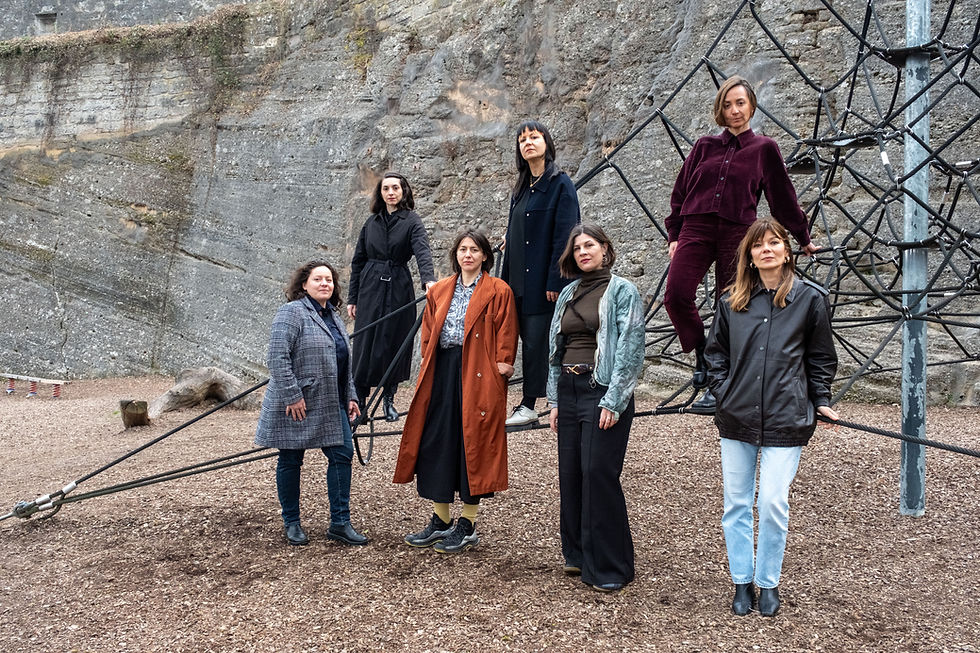
The Federation of Minor Practices, Bulgaria's pavilion at the 60th La Biennale di Venezia, takes the form of a speculative research laboratory imagined from a future looking back at our present. Conceived by curator Martina Yordanova, the pavilion brings together four artists: Veneta Androva, Gery Georgieva, Maria Nalbantova, and Rayna Teneva, none of whom had previously worked together, alongside an interactive video game that transforms visitors into active participants shaping a collective environment. At its heart, the project is preoccupied with what it means to imagine and care for futures that do not yet exist, at a moment when the present can feel closed or exhausted. In the conversation below, Yordanova reflects on the curatorial thinking behind the pavilion, from its use of speculative fiction as a political tool to the shared sensibilities that made this unlikely collaboration possible.


A group of people standing in front of a tree
The Bulgarian Pavilion Team. Image credit: Maximilian Pramatarov.

The Federation of Minor Practices is framed as the headquarters of a fictional research lab looking back at the early 21st century from an imagined future. What drew you to speculative fiction and futurity as curatorial tools for addressing contemporary political and ecological realities?

What drew us to speculative fiction as a curatorial tool was precisely its ability to move between the conditions of the present and the possibility of imagining otherwise. The project emerged from a feeling that we are living in a moment of political, social, and ecological detention, a condition in which crises accumulate so rapidly that the present often appears closed or difficult to transform from within. In such a climate, imagination becomes not an escape from reality, but one of the few remaining spaces where different futures can still be rehearsed, tested, and collectively articulated.


The fictional framework of The Federation of Minor Practices allowed us to create a certain distance from the immediacy of the present. By imagining a research laboratory looking back at the early 21st century from a speculative future, we could approach contemporary conditions almost archaeologically — as if examining the emotional, ideological, and material traces of our current moment from another temporal perspective. This displacement opens a space where systems that seem permanent today suddenly appear fragile, absurd, or historically contingent.


Futurity in the exhibition is not connected to technological optimism or utopian certainty. It is much more fragile and intimate, existing in gestures of collective survival, minor forms of resistance, alternative systems of care, and the capacity to imagine coexistence beyond dominant political structures. Even the act of imagining a future already implies the possibility of change. The future is always approaching us, but imagination is what allows us to enter it before it arrives.


In this sense, speculative fiction became a method for thinking through the present rather than escaping it, a language through which anxiety, collapse, hope, and political desire could coexist without needing to resolve themselves into a single narrative.


You describe the Pavilion as sustaining "the conditions through which futures begin to take form collectively, attentively, and through care." How do you define "care" within the context of this exhibition, and how did that idea shape your curatorial decisions?

Within the context of the exhibition, care is not understood simply as protection or maintenance, but as an active way of relating to the future and to one another. One of the central questions for us was: what does it mean to care for something that does not yet fully exist? If the future is still open and unstable, then care becomes the way we approach it, imagine it, and take responsibility for the conditions that might shape it. Our actions, gestures, and political choices are constantly projecting possible futures, care is inseparable from imagination. To care about the future means to remain attentive to what kinds of worlds we are already producing through the ways we live today.


The exhibition also approaches care as something deeply relational and collective, existing in subtler forms of attention, listening, withdrawal, coexistence, and mutual sensitivity. Sometimes care means making space for someone else; sometimes it means resisting the impulse to dominate, explain, or occupy. We became interested in these minor gestures and fragile forms of interdependence that often remain invisible within larger political systems, but which nevertheless sustain the possibility of living together.


This understanding shaped the curatorial process in multiple ways. It influenced how the exhibition space was conceived as an environment that encourages attentiveness, slowness, and reflection. It also shaped the relationships between the works themselves, privileging dialogue, resonance, and collective thinking over singular statements or fixed conclusions. Rather than presenting the future as a resolved vision, the exhibition attempts to sustain the conditions through which futures can emerge collectively, through vulnerability and shared responsibility.


Different squares resembling a TV network channel
A still from Gery Georgieva's 'UWU Channel Radiance'. Image credit: Gery Georgieva.

The four participating artists had never worked together before. What connections or shared sensibilities did you see between their practices that made this collective framework possible?

Although the four participating artists, Veneta Androva, Gery Georgieva, Maria Nalbantova, and Rayna Teneva  had never previously worked together, there was a strong underlying sensibility connecting their practices from the very beginning. What became important was not similarity in form or medium, but a shared attentiveness to the conditions of the world we inhabit and the subtle ways in which contemporary realities manifest through personal, social, political, and ecological experience.


Each artist approaches these questions differently, proposing distinct visual languages and narrative structures, yet all of the works operate almost as symptoms or signals of the society we have inherited and continue to reproduce. Many of the films and artistic gestures trace the preconditions of the present moment, examining fragments of the recent past in order to better understand the anxieties, contradictions, and emotional textures of contemporary life. The works remain deliberately sensitive and open-ended revealing particular layers of reality with a certain fragility, and allowing space for ambiguity, vulnerability, and reflection.


What ultimately made this collective framework possible was precisely this shared capacity for attentiveness. Each artist maintains a very autonomous voice and perspective, but together the works create a larger field of resonance. Their differences as artists allow for a polyphonic structure in their works where multiple ways of perceiving and navigating the world coexist simultaneously. The exhibition became a space where individual positions remain distinct, yet enter into dialogue through a shared sensitivity toward the political and emotional complexities of the present.


Across the films, there is a recurring tension between systems of extraction or control and forms of care or resistance, from algorithmic disinformation to ecological maintenance and arms production.
Was this thematic dialogue something that emerged organically, or was it central from the outset?

The thematic dialogue was present from the outset, although the way it unfolded within the exhibition eventually acquired a much more organic and relational quality. As a curator, these were questions I had been observing for several years, both within broader social and political developments and within the individual artistic practices of the 4 exhibiting artists. What interested me was the way each of them was already engaging, through very different methodologies and visual languages, with questions connected to labor, technological mediation, ecological fragility, collective memory, systems of power, and the emotional conditions of contemporary life.


In that sense, the constellation of topics was a deliberate curatorial decision. At the same time, it never felt imposed onto the works. The exhibition developed more like a gradual process of listening to the resonances already existing between the practices. Although each artist approaches these issues from a distinct position, there is a shared sensibility that runs through all of the works, a sensitivity toward the vulnerabilities and contradictions embedded within contemporary society. This is what ultimately created the feeling of cohesion and organic dialogue within the pavilion.


A man reaching out to touch a flower.
A still from Rayna Teneva's 'Geography is Destiny'. Image credit: Rayna Teneva.

Rayna Teneva's Geography Is Destiny documents and perhaps juxtaposes the co-existence of rose harvesting with arms production in Kazanlak. How important was it for the Pavilion to foreground the contradictions embedded within local histories and economies in Bulgaria?

Foregrounding such contradictions was very important for the pavilion because they reveal how complex and layered contemporary reality actually is. In Rayna Teneva’s Geography Is Destiny, the coexistence of rose harvesting and arms production in Kazanlak becomes almost symbolic of the tensions embedded within local histories and economies in Bulgaria. Beauty, labor, violence, tradition, and industry exist simultaneously within the same landscape.


What interested us was not simply exposing these contradictions, but showing how societies normalize them and continue to function through them. The work avoids simplistic judgment and instead creates space for reflection on how geopolitical realities, economic survival, and cultural identity become intertwined in everyday life. In many ways, these local conditions also resonate far beyond Bulgaria, reflecting broader global tensions between care and destruction, preservation and exploitation.


The Pavilion is conceived as an interactive environment based on a computer game. What possibilities did the language of gaming and play open up for you that a more traditional exhibition format might not have allowed?

The decision to include a video game emerged directly from the idea of constructing the pavilion as a speculative research laboratory rather than a traditional exhibition space. None of the artists had previously worked with gaming, which made the process itself an experiment, and that was precisely what made it exciting. The game allowed visitors to become active participants, not simply observers or consumers of artworks, but players whose decisions actively shape the environment around them.


Through the structure of the game, visitors are constantly confronted with choices and ethical positions. Their decisions affect different indexes connected to care, power, transformation, truth, and fear, which continuously shift according to the collective actions of everyone participating. The pavilion therefore exists in a permanent state of transformation, reflecting a constantly changing collective psychology. Every action leaves a trace and contributes, even subtly, to a shared condition.


The game itself, Kazana, takes its name from the kazan, the traditional copper cooking vessel used across many cultures in the Balkans and beyond. The structure where the game is played recreates the form of this vessel and becomes the symbolic center of the pavilion. Historically, the kazan is associated with collective gathering, and care, often connected to communal cooking traditions led by women. We became interested in it both as a metaphor and as a social structure as different ingredients coming together to create something collectively. In many ways the pavilion functions similarly as a space where different voices, choices, and emotional states are continuously mixed into a shared speculative reality.


A still from Maria Nalbantova's 'Swamp Song'. Image credit: Maria Nalbantova.

Maria Nalbantova's work at Dragoman Marsh is described as a long-term practice of ecological care involving both artistic research and environmental maintenance. How do you see the relationship between artistic practice and forms of ongoing civic or ecological responsibility?

Maria Nalbantova’s work at Dragoman Marsh was important for the pavilion precisely because it approaches artistic practice not as representation alone, but as a long term form of attention, responsibility, and presence. Her practice moves between artistic research and direct ecological engagement, showing that art can also function as a sustained relationship with a place and its fragile ecosystems.


What becomes significant here is the idea that care is not symbolic or temporary. It requires continuity, maintenance, and an ongoing commitment to the environments and communities we inhabit. In this sense, artistic practice can create alternative models of civic and ecological responsibility, not through grand gestures, but through persistence, sensitivity, and the ability to remain attentive over time.


Commissioner Dessislava Dimova describes the Pavilion as part of Bulgaria's growing presence at the Biennale. What does it mean to you to present a project like The Federation of Minor Practices on an international platform such as the La Biennale di Venezia, particularly in terms of how contemporary Bulgarian art is perceived globally?

While the pavilion is presented within the context of Bulgaria's national participation at La Biennale di Venezia, its significance goes beyond the idea of representing "Bulgarian art" as a fixed category or identity. What became important was to create a project that speaks from a specific context, but is not limited by it. The questions the pavilion addresses which are connected to care, political anxiety, ecological fragility, technological systems, and collective futures, resonate globally.


The project inevitably carries certain experiences and sensitivities shaped by the social and historical realities of Bulgaria and the broader region. The pavilion, however, also proposes a more fluid and relational understanding of cultural production that positions artists from Bulgaria as part of larger international conversations.


This also matters in terms of how contemporary art from Bulgaria is perceived internationally. There is often an expectation for artists from Eastern Europe to represent trauma, or geopolitical transitions in very direct ways. What interested us instead was creating a project that remains politically and socially engaged, but also speculative, poetic, and sensitive. In that sense, The Federation of Minor Practices ultimately makes a proposition for how art can imagine other modes of coexistence and collective thinking today.

INTERVIEWS
Mens Journal 1x1.png
RECENT POSTS
Mens Journal long.png

© 2023 by New Wave Magazine. Proudly created by New Wave Studios

bottom of page