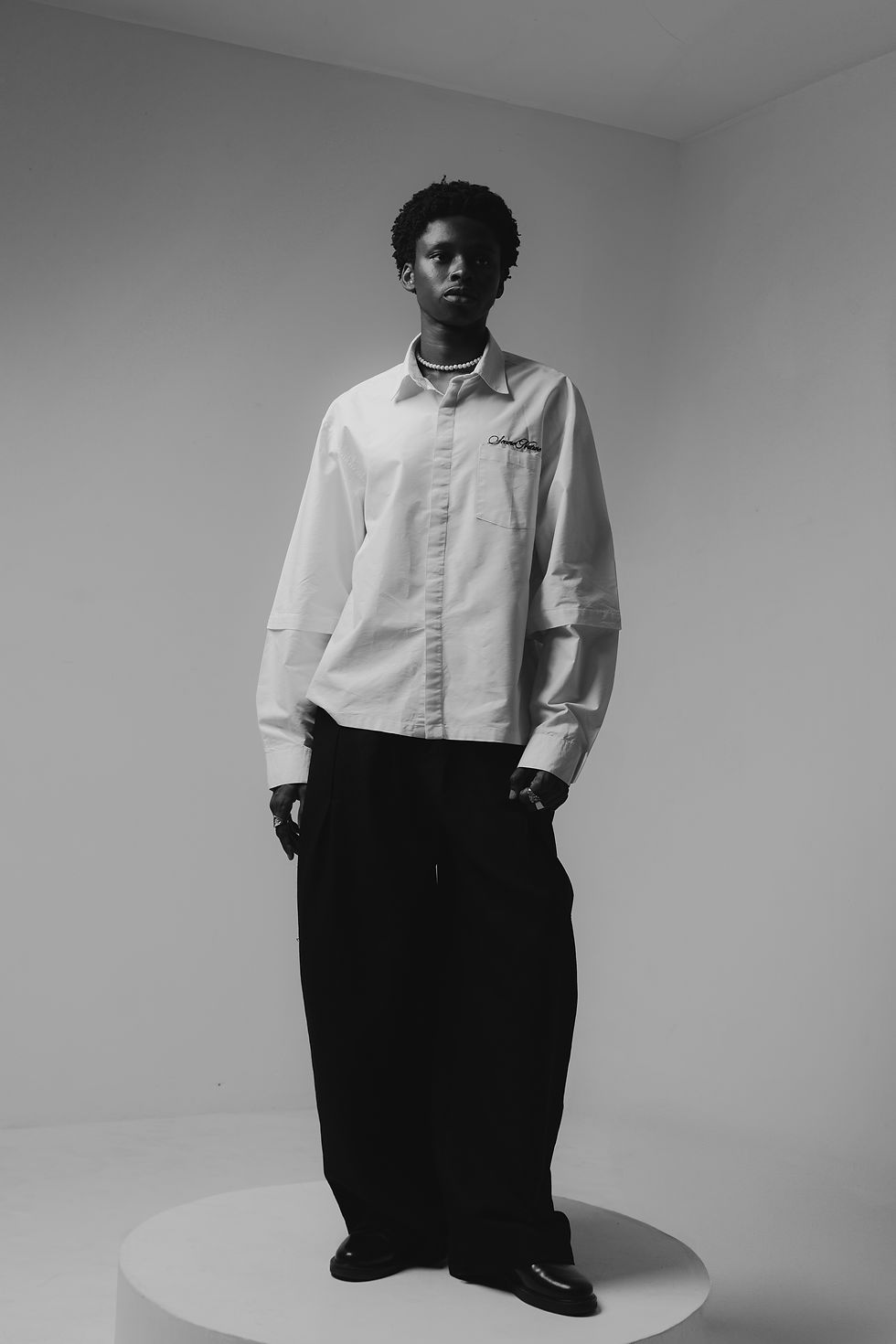
Little Us: Ekene Obiago's Conversation With His Younger Self
top of page

Little Us: Ekene Obiago's Conversation With His Younger Self

Popular music has long been fueled by aspiration. Across genres, artists frequently frame success in terms of what comes next: the mansion, the luxury car, the chart-topping album, the lifestyle they’ve yet to reach

Ekene Obiago has been looking in the opposite direction.


His latest project, Little Us, isn’t preoccupied with the future. It turns its attention to childhood, not out of nostalgia, but in search of something adulthood has a way of obscuring. 


Across the album, Ekene revisits an earlier version of himself, the boy who believed possibility had no edges, before caution, responsibility and self-consciousness began to narrow the frame.


“The project was really me communicating with my younger self,” he says. “The part of me that didn’t give himself permission to go after the things he believed in.”


That conversation sits at the centre of Little Us. The album isn’t interested in reliving childhood so much as understanding what was lost in the transition to adulthood. However, not innocence, but the instinct to believe that life could unfold in countless directions before experience began editing those possibilities.


When I suggest that wonder has become a rarer emotion in popular music, Ekene smiles before gently pushing back.

“I don’t think we’ve lost wonder,” he says. “I think it just takes different shapes.”


For him, children embody wonder because they haven’t yet learned where possibility is supposed to end. They dream first and negotiate with reality later. That way of seeing the world became one of the emotional anchors of Little Us.


“The kind of wonder I wanted to capture was dreaming in the same way a child dreams,” he says. “When everything still feels possible.”


That way of thinking shapes how Ekene understands memory, as he doesn’t see it as a record of the past so much as the thing that gives the present its shape. 


Every experience, every conversation and every disappointment gradually becomes part of the person who emerges on the other side.


“If someone wiped your memory,” he says, “you’d become a different person.”


It’s a simple thought, but one that runs through Little Us. The album keeps returning to earlier versions of himself because that’s where its questions begin. Some of those memories remain vivid. Others have faded almost completely.

“There are parts of secondary school I barely remember,” he admits. “Sometimes I wish I could go back, just to understand what happened.”


Those gaps became as important as the memories themselves. They aren’t missing pieces to him; they’re reminders that identity is defined as much by what slips away as by what stays.


But memory is only part of the story… When I ask him what feeling from childhood he’d preserve forever, not a memory, but a feeling, he doesn’t pause.


“The feeling that I could become anything.”


As we get older, he says, possibility begins to negotiate with reality. Responsibilities arrive. Expectations settle in. You become more aware of what you can lose than of what you might discover.


“I wish I could preserve that feeling,” he says. “The feeling that anything was possible.”


That longing gives Little Us its emotional centre. The album is not trying to return to childhood, however, searching for the openness that childhood made feel natural.


That same instinct curates the way Ekene writes.


He doesn’t think of vulnerability as a creative choice or a way of making songs feel more personal. For him, it’s a test.

Whenever a lyric makes him hesitate, whenever he wonders if it’s too revealing or too uncomfortable, that’s usually the one he keeps.


“If I’m second-guessing whether people should hear something,” he says, “that’s probably the thing I need to write about.”


Listening back to older records has become another kind of conversation. He hears patterns he couldn’t recognise while he was living them. Songs that once felt like isolated moments now reveal themselves as chapters in a longer story.


“It’s like opening an old diary,” he says. “I realise things about myself that I didn’t know when I was writing them.”


For Ekene, music doesn’t simply preserve emotion. It helps him understand it.


“It’s almost like crying,” he says. “Afterwards, you feel lighter.”


That search for possibility extends beyond Little Us. It shapes the way Ekene thinks about R&B itself.


While Afrobeats continues to dominate commercial conversations, he’s less interested in chasing prevailing sounds than in exploring what Nigerian R&B can become. Too much of the genre, he believes, still draws heavily from American traditions. The opportunity lies in allowing it to absorb different influences until it reflects the complexity of the place it comes from.


“I want to hear more experimentation,” he says. “I want to hear more of us in the music.”


That instinct reaches back even further than the album.


Before there were studio sessions or streaming platforms, there was church. Singing in the choir introduced him to music as something birthed in feeling and storytelling long before he considered it a career. Looking back, he sees those years not as a separate chapter, but as the foundation everything else was built on.


Choosing music, however, was never the obvious path. Like many Nigerian parents, his initially saw it as an uncertain profession rather than a viable future. Pursuing it anyway meant accepting that conviction would have to come before certainty.


Today, that decision feels less like a leap of faith than an acknowledgement of something he could never have ignored.

When I ask what he hopes listeners take away from Little Us, he doesn’t mention streams, chart positions or commercial success.


Instead, he hopes the album encourages people to return to parts of themselves they’ve stopped listening to.


“I want someone to hear a song and remember a moment they’ve ignored,” he says. “Something that shaped them, but they never really sat with.”


By the time our conversation ends, it becomes clear that Little Us is about recovering a way of seeing the world that adulthood has a habit of leaving behind.


Not because the past is a place to live, but because it still has something to teach.


INTERVIEWS
RECENT POSTS

© 2023 by New Wave Magazine. Proudly created by New Wave Studios

bottom of page