top of page

Grace Ladoja, Homecoming 2026, and What It Means to Build Something That Actually Belongs Here

It wasn’t my first time speaking with Grace Ladoja.


The two times before this were in person: once during Homecoming and once at the opening of the Concept Space. Both times, conversation happened the way it does in Lagos: in the middle of something, surrounded by energy, without the luxury of full sentences. This time was different, a call, quiet enough actually to listen.


What we noticed almost immediately was the ease. Not the ease of someone who’s switched off, but the ease of someone who has done the work so many times that confidence has become a resting position. There’s a certain quality to people who’ve built things, they don’t need to convince you. That’s the energy we got from Grace.


For me, Homecoming has long stopped being an event. Over the past four or five years, it has become a marker in the calendar that announces itself the way Easter does. When it arrives, you know something is about to begin. That kind of cultural anchoring doesn’t happen accidentally. It is engineered by someone who understands what it means to build for a place rather than simply in it.


Before we could say much, Grace turned the lens around.


“What do you think we should do better?”


It was a disarming question, the founder asking the observer to critique the system. It collapses hierarchy fast. We told her we thought the Concept Space had potential for deeper integration, that there was more room to stretch. She stopped me gently.


“We haven’t launched properly. We’ve just been doing a soft launch. We’re launching for Easter.”


“Now that we’re here,” she continued, “it’s about connecting with what people actually want and need for the city. When I first came here and started working, in 2015, some of the people who were five years old then are now shopping with us. It’s a different time. So I’m always open to feedback.”


This is Version 2.0. And already, it’s working.


Most people know Homecoming as the festival. Fewer understand the architecture behind it.


Grace’s ecosystem has three distinct parts: Metallic, the global culture studio she co-founded with Alex Sosah; Homecoming, the platform; and a wider layer of projects, artists she manages, and interventions she initiates. They’re distinct, but they feed each other.


Metallic came first. It started around her work with Skepta in 2015, a gap between music, brands, and youth culture that no existing agency was filling. What they built was not just an agency, but a system for placing culture at the center.


Homecoming came out of a different question—a more personal one.


“If I were born here, could I be Grace?”


She poses this to herself regularly. It’s her north star. It asks whether the ecosystem she’s building could have produced her, had her circumstances been different, whether the opportunities she accessed in London could exist for someone starting in Lagos.


That’s the brief. Everything else is a response to it.


The programming follows that logic. At Homecoming’s shows, there are no headliners. When Central Cee came, he performed fourth out of forty artists. When Wizkid performed at an early edition, he remarked he had never been at a show and had not come on last. That was the point. The space is about shared footing, not hierarchy.


Homecoming 2026 opened not with noise, but with attention.


The first day was anchored by an art tour, a deliberate, unhurried movement through Lagos’s custodians of visual culture, including Dada Gallery. It signaled intent that art is not decoration here, it is orientation and communication.

That evening, Wine & Vinyl Night at Suudu carried a different energy, intimate, warm, familiar. BOJ was there and other familiar faces. The music was unhurried. It felt less like an event and more like a room that had always existed, you just hadn’t found it yet.


The following day introduced the Patta Run. Run clubs have quietly become a new third space in Lagos, part fitness, part networking, part belonging. The Patta Run understood this. It was merely a branded moment. It was the body as a site of connection.


If there is one thing that separates Homecoming from most festivals on the continent, it is the Summit.


The 2026 edition carried that weight. Across fashion, music, art, sport, and beauty, the conversations brought together Tunde Balogun, Irene Agbontaen, Blessing Ewona, Iretidayo Zaccheaus, Anthony Azekwoh, Richard Vedelago, Clint, Gabriel Moses, Aniko, Stephen Tayo, the FTY team, and others.


Each contributed something that couldn’t be replicated elsewhere.


This is what Grace means when she talks about exchange. Not just proximity between Nigerian and international talent, but conversations that can only happen here, born in Lagos, in this moment, in the reality of building culture within a country where over 70% of the population is under 25.


“How do we create jobs for 150 million young people in Nigeria?” she asked. “Not everyone can be an artist. Not everyone can be a designer. There’s so much to do; lawyers, accountants, managers. Right now, most of those roles are filled by people outside Nigeria. That’s a gap. But it’s also an opportunity.”


The Summit is where that gap begins to close.


Later that evening came the Nike TN launch.


The collaboration had already traveled globally, covered, dissected, but what that coverage missed was what the shoe represents from within. From the perspective of someone who once walked across London to buy Air Maxes, and now shapes how Nike engages with culture on this continent.


Grace and Alex worked on the shoe for nearly three years.


Every detail was intentional. The slip-on design reflects how Lagos moves, fast, without pause. The laces are expressive, drawing from London styling and Nigerian exuberance. The charms, black planet, eagle, and cowrie, carry layered meaning.


“The African sunrise inspired the yellow,” she told me. “If you’ve ever woken up early here, it’s more orange than anywhere else.”


Even in what didn’t make it, the attempt to include Somalia’s blue, the ambition remained.


The shoe is more than a product. It is a position.


Day Three shifted the focus to space.


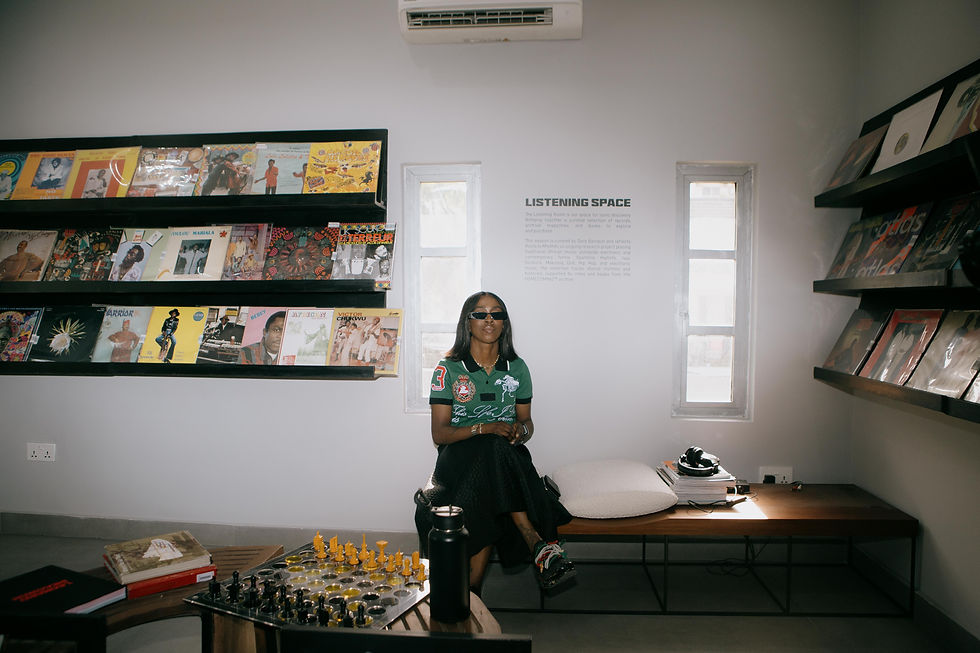
The Concept Space became the story. Not quite a store, not quite a hub, something more fluid.


“I come from a shop I loved growing up called Colette,” she said. “You could walk in and see Kanye West performing or an artist painting the shutters. It’s about the energy of what’s happening.”


That’s what the Concept Space is attempting in Lagos. Brands like Billionaire Boys Club, Ambush, and Nocta sat alongside local labels. Exclusive products moved through quietly, carrying a kind of cultural value that money alone can’t manufacture.


From there, the energy moved outward.


The WAF Skate Jam at Freedom Park felt like recognition more than programming. Skate culture in Lagos is young, active, and under-documented. Giving it space felt necessary.


Then came the football.


The Sanwo-Olu Mini Stadium carried everything Grace had described, street football as raw talent, grounded instinct. The Plug Team took the tournament, but the presence of Jay Jay Okocha and Obafemi Martins added something deeper: a bridge between legacy and the present.


“Africa has so much potential to bring new superstars out if they’re nurtured,” she said. “Street football shapes how players think. It stays with them.”


Before the live show, everything returned to something older.


E Jé Ka Jọ at the New Afrikan Shrine.


The Shrine is not just a venue, it is memory, politics, and lineage. Homecoming brought its audience a statement: the roots are still active.


King Sunny Ade, Lady Donli, and Others performed.


The combination felt like continuity without explanation.


Then came the live show on the final day.


Still the most radical programming decision: no headliners, no hierarchy. The experience is built on flow, not climax. Artists like No11, Zaylevelten, and Strafiti carried that energy, emerging, uncertain, but clearly holding something.

That uncertainty, coming from Grace, is its own endorsement.


After everything, the art tour, the run, the Summit, the launch, the skate jam, the football, the Shrine, the show, what is Homecoming?


It is not just a festival. It is a system being built in real time.


The music camp, the locally produced “Product of Africa” blanks, the print facility, the Concept Space, these are not just programming decisions. They are responses to a larger question, one iteration at a time.


“Done is better than perfect sometimes,” she said. “Get it out, then refine it. If I waited for the Concept Space to be perfect, we wouldn’t have opened.”


There’s a final thing she said that stays with me.


“Your mind. Protect your mental health. Protect your peace. Don’t get derailed by noise. Just work.”


And then:


“Craft matters. There’s a tendency to think you’re better than you are. We need to raise the bar. When individuals improve, the whole ecosystem improves.”


Lagos is the brief.


Every moment, Homecoming gets closer to the answer.


Comments


INTERVIEWS
Mens Journal 1x1.png
RECENT POSTS
Mens Journal long.png

© 2023 by New Wave Magazine. Proudly created by New Wave Studios

bottom of page