top of page

Exposing the Illusion: How the Sam Wanamaker Playhouse is Reimagining Who Tells the Story

Updated: Mar 3

Lit by over a hundred beeswax candles and modelled on the intimate indoor theatres that Shakespeare himself knew, the Sam Wanamaker Playhouse has always carried a paradox at its heart. It is a space built to honour a specific theatrical tradition, and yet the two productions it is currently housing work hard, and in very different ways, to unpick exactly whose tradition that is, and who has historically been permitted to inhabit it.


Running in repertoire through to April, Tim Crouch's production of The Tempest and Tristan Fynn-Aiduenu's UK premiere of Chadwick Boseman's Deep Azure together make a bold curatorial statement: that Shakespeare's house is not Shakespeare's alone. Both productions insist that the stories told within it must now answer to the people those stories have historically been spoken about rather than for.


A group of people crouched together, they are made up of a woman and two men
Aminita Francis as SK Good, Imani Yahshua as SK Evil and Jayden Elijah as Deep in Deep Azure at Shakespeare's Globe. Image Credit: Sam Taylor

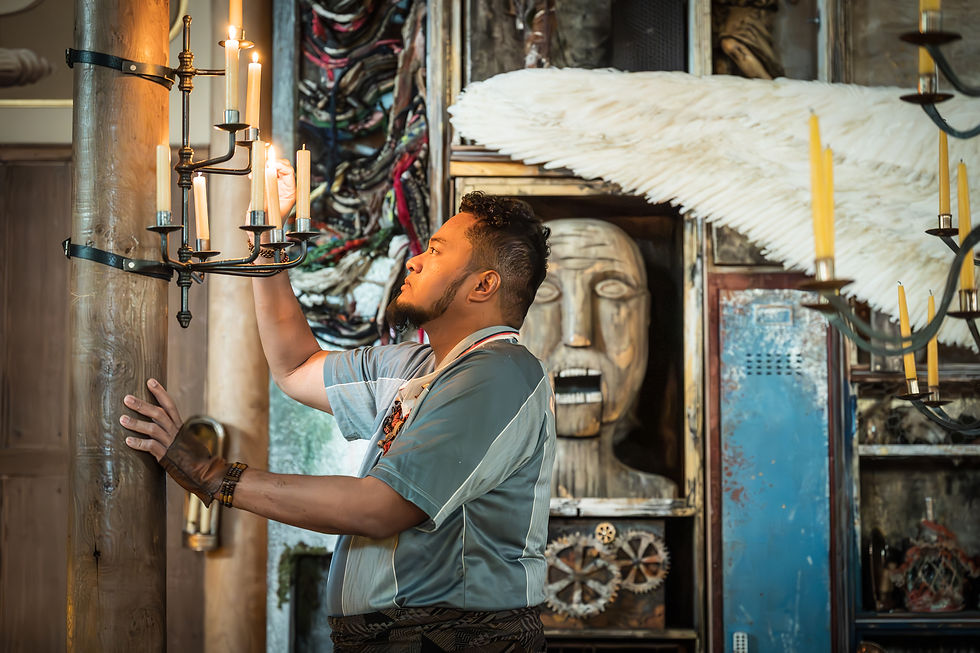
The Tempest has long been a lightning rod for post-colonial readings. Shakespeare's play about a sorcerer who rules an island through illusion and manipulation has been claimed again and again as an allegory of empire, with Caliban, the island's original inhabitant, as its most contested figure. Crouch's production makes this structural rather than merely thematic. The set is made up of objects which the characters handle and move themselves, so the audience sees exactly how the illusion is being constructed, and by extension, who has always been doing the constructing. This extends to the casting of the audience itself, as actors jump from their seats to play their parts before sitting back down among us. Within this framework, Caliban, played by Faizal Abdullah, speaks at points in Singaporean Malay as a rejection of Prospero's language that lands before a word of the argument needs to be understood by the audience. Naomi Wirthner's Ariel operates differently but to the same end as her precise, anchored delivery feels almost classical, and it is precisely that command which makes her rejection of the character's conventional liveliness so pointed. Where Crouch works from within Shakespeare's text to dismantle its power structures, Chadwick Boseman's Deep Azure, however, builds something new from the outside in.


A man photographed standing in profile, he is touching some candles
Faizal Abdullah as Caliban in The Tempest. Image credit: Marc Brenner
Two women sat together knitting
Naomi Wirthner as Ariel and Sophie Steer as Miranda in The Tempest at Shakespeare's Globe. Image credit: Marc Brenner

At the centre of Deep Azure is Selina Jones as Azure, a Black woman whose grief over her killed fiancé becomes the engine of everything that follows. It is a performance that makes visceral what systemic violence does to a body long after the moment of harm, her portrayal of an eating disorder carrying a weight that the play's more surreal diversions never quite displace. That Chadwick Boseman, writing in 2005 and long before his global recognition as T'Challa in Black Panther, could construct a work of such painful contemporary relevance reveals the full scope of his artistry. The idea behind the play was sparked by the real death of Prince Jones, a university student shot by a police officer in 2000, and routes its grief through hip-hop, producing something raw and politically alive. Placed alongside The Tempest, it becomes clear that both productions are pulling at the same loose thread, just from opposite ends.


Where Crouch's Tempest foregrounds the exposure of theatrical illusion, reminding audiences they are watching a construction, Deep Azure dissolves those boundaries through sound and collective energy. The ensemble move between functions and forms with ease, grounding the play's more surreal diversions in physical immediacy. Azure's friends Tone and Roshad carry their own weight in the grief, but the play does not try to tidy any of this up, which is precisely its point.


A woman standing centre stage
Selina Jones as Azure in Deep Azure at Shakespeare's Globe. Image credit: Sam Taylor

What is striking about placing these two works together in the same intimate space is what they share beneath their differences. Both are concerned with who controls the narrative. Both restore agency and complexity to figures who have historically been marginalised or erased, whether that is Caliban and Ariel on a colonised island, or a Black community in America denied justice. Both also refuse to let the dominant culture's story go unchallenged.


The Sam Wanamaker Playhouse, named after the American actor and director Sam Wanamaker who campaigned for decades to rebuild Shakespeare's Globe, is itself a monument to the belief that some stories are worth fighting to tell. The irony that this space was conceived in honour of the European theatrical tradition is not lost on a season that is busily and purposefully dismantling that tradition's exclusions from within. These walls have always been built for theatrical magic but this season asks, bracingly, whose magic counts.

Comments


INTERVIEWS
Mens Journal 1x1.png
RECENT POSTS
Mens Journal long.png

© 2023 by New Wave Magazine. Proudly created by New Wave Studios

bottom of page