top of page

Yang Liu: Trust In Fracture


Before It Gives Way, The Alchemy Experiment, Glasgow, 2026


Reality is not something we simply witness but something we construct, moment by moment, out of our senses, our surroundings, the cultural systems which shape how we read the world, and the private experiences that make each of our perspectives different. We trust that the next second will resemble the last, that gravity will still be there tomorrow, that language will stay understandable long enough for us to read the text. Most of the time we never observe this trust because it is never broken. This is when Yang Liu's work destroys it. She plays with our trust, with our anticipation that something will start again or with our fear that something will end rapidly, that something won't be regenerated. She leaves us unsatisfied, wanting more, wanting to trust again.


Yang Liu, CDT-0180-10, 2026, multi-media installation, 30cm X 30cm X 30cm


Yang Liu, The midges, 2025-2026, AI generated loop video, dimensions variable


Yang, a conceptual artist born in 1988 in China and now based in the United Kingdom, treats reality as something built rather than fixed, and her work explores what happens when that construction falters. She sharpened this idea during her MA at the Glasgow School of Art, which she completed in 2024. Her pieces stage instability directly for the viewer, unsettling our sense of time, space, or self until the ground we normally take for granted becomes visible only because it has given way. What sets her apart from other artists working in similar territory is that she doesn't treat disruption as the point of the work. For Yang, breaking someone's certainty isn't the goal, it's a method: a way of opening up space in which something more authentic than habit might briefly come into view.


Yang Liu, Clock, 2024-2026, aluminum truss, rusted screws, electric motor, spotlight


That method is clearest in "Clock", a mechanical sculpture she presented this July in her solo exhibition "Before It Gives Way" at The Alchemy Experiment. A huge metal hand rises steadily, then drops suddenly under its own weight. The rhythm invites trust almost immediately, and the drop breaks that trust the moment it settles in. What stays with me is not the drop itself but the sound that follows it, a mechanical impact that turns something purely visual into something registered through sound as much as sight. It is a demonstration of how easily perceptual certainty collapses once it's tested, and how much of that certainty was habit rather than knowledge to begin with.


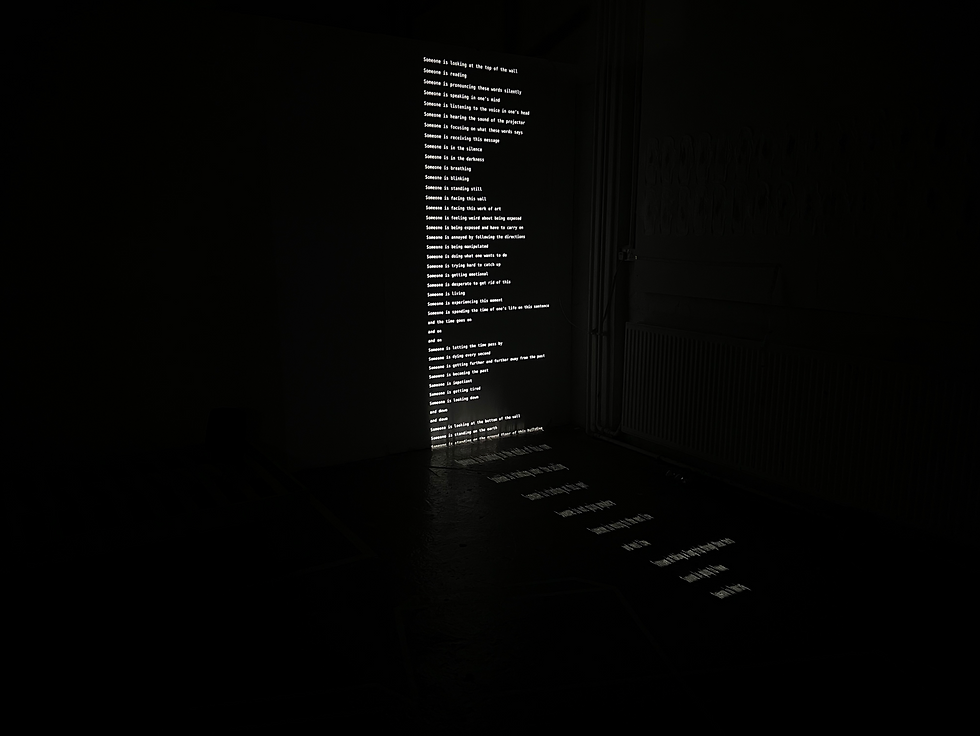
Yang Liu, Someone,2024, 3 minutes’ loop video, amplified noise of a projector


Elsewhere in her practice, "Someone" reaches the same territory in a different way. Projected text describes the viewer's own present-tense actions back to them, while the text itself glitches mid-sentence. The effect is a genuine uncertainty over which register, read, spoken, heard, holds the true "I." It is a rare text-based work that makes the instability of selfhood felt rather than merely asserted, and it does so without relying on the kind of visual shock that "Clock" uses to the same end.


Yang Liu, Someone, 2024, 3 minutes’ loop video, amplified noise of a projector.


In "All of us", Yang shifts register again. Thousands of birthdates on A4 paper, weighted by stones, updated daily so the work stays alive rather than fixed. Where the other two pieces unsettle, this one offers something closer to solidarity, the shared, unglamorous fact that everyone alive is moving through the same fragile passage of time. Read against "Clock" and "Someone", it reframes Yang's method: disruption is not her only tool. Recognition can do the same excavating work from the opposite direction, arriving at the same question of authenticity by asking what, if anything, we hold in common rather than what separates our individual perceptions.


Yang Liu, All of us, 2024, print A4 paper, stones, 231cm X 237.6cm.


To me, these three works don't stage chaos for its own sake. They search within it, patiently, for something more authentic than the habits of perception usually allow us to notice, the pursuit of an unattainable certainty that Yang's own writing identifies directly as central to what drives the work. That search is what gives a genuinely unified inquiry to a practice working across such different formal means, mechanical, textual, collective, and it's an inquiry for which "Before It Gives Way" offers just one recent chapter rather than the whole story. I would like to see her push further into how different audiences, by age, culture, language, experience these ruptures, since her own writing already flags this as an open question worth pursuing empirically rather than theoretically.


Yang Liu, All of us, 2024, print A4 paper, stones, 231cm X 237.6cm.


Yang Liu (@wudiliuyang001) is a conceptual artist based in the United Kingdom. Working across time-based and spatial media, her practice investigates how perception of reality is constructed and destabilized through experiential and temporal conditions. Her work often stages situations in which perceptual certainty is disrupted, shifting the viewer’s relation to time, space, and lived experience. She received an MA from the Glasgow School of Art in 2024.


Sophie Nowakowska (@professional_art_bullshitter) is an independent curator, artist manager and an art critic with a Master's in Curating Contemporary Art from the Royal College of Art. She is currently pursuing a PhD in Art Criticism at Central Saint Martins, University of the Arts London.


Sophie serves as a mentor at I LIKE NETWORKING, an award-winning career platform supporting underrepresented groups in the creative industries. 


She has delivered talks at UAL, VISP, WORK SHOW GROW, AA2A and may more. She also participated in panel discussions hosted by the All About Art Podcast, and served as a judge for an award at ST.ART Gallery. Additionally, she has curated two commissioned exhibitions for Crawley Council and is a Founding Member of the Critic's Picks.

Comments


INTERVIEWS
RECENT POSTS

© 2023 by New Wave Magazine. Proudly created by New Wave Studios

bottom of page