
top of page

Choosing the Right Custom Signs for Doors

20 minutes ago
4 min read

When a new office building opens or an existing property is renovated, door signage is one of the details that has to work across the entire space. Suite numbers need to be easy to locate, room names need to follow the same visual system, and the signs need to suit the doors they are installed on.

Problems usually appear when these details are decided separately or too late. A sign may be correctly sized for the wall but look out of proportion on the door. The mounting method may not suit the door surface. Materials and finishes may also need to be considered alongside the interior and the conditions of the space.

Planning these details early makes it easier to create a signage system that is consistent, practical and visually integrated with the interior.

Look at the door before you look at the design

It's natural to start with the fun part — picking a font, a finish, a shape that photographs well. The trouble is that the door itself dictates most of what's actually possible, and that part gets sorted out far too late in a lot of projects.

Wood, acrylic and stainless steel can create very different visual effects, and the door surface also matters when planning the installation. A smooth, flat door provides a different base for a sign than a textured wood surface or a door with raised panels. The mounting method should therefore be considered together with the material, finish and geometry of the door to achieve a clean, secure result. 

Then there's what's behind the door surface. Hollow-core doors, glass panels, and doors already loaded with closers, panic bars, or weatherstripping don't leave much room for drilling without running into something or voiding a warranty.

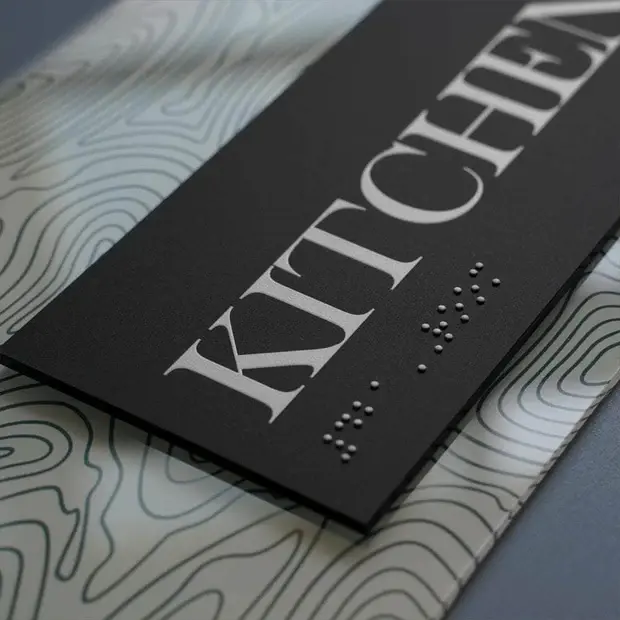
When a project has unusual door finishes or installation constraints, the mounting surface should be checked before production. Custom signs for doors can then be adapted in size, shape, and material to suit the location.

Picking a material that fits where it's going

Door signs get more abuse than people expect. Hands brush against them constantly, cleaning crews hit them with chemicals every night, lobby windows throw direct sun on them for hours, and anything on an exterior door deals with humidity and temperature swings on top of all that. So the material has to answer to its actual environment, not just how it looks in a catalog photo.

There isn't a single right answer here. It comes down to whether the sign lives indoors or out, how rough the cleaning routine is, and how much wear the door around it already takes.

Size, shape, and why they're not just about looks

A sign scaled for a wide commercial entrance can look oversized on a narrower interior office door, and the reverse is just as awkward. Beyond how it looks, size affects whether people can actually read it from a normal distance in a hallway or lobby — a plaque that's perfectly legible up close but difficult to read from across a hallway.

Shape matters too, more than people usually assume. Rectangular plaques are the default because they're simple to make and mount, but doors with narrow stiles, decorative panels, or sidelights sometimes just don't have a flat rectangular space to work with, and the shape has to follow the door rather than the other way around. This is exactly the kind of detail architects and interior designers tend to flag during a walkthrough but that can get lost if signage is ordered off a generic spec sheet instead.

The mounting question people forget to ask

Three common mounting approaches are adhesive, standoffs or studs, and direct mechanical fastening. Adhesive is the least invasive option and works fine on smooth, non-porous surfaces, but it loosens over time on textured or oily surfaces, or anywhere that gets wiped down constantly. Standoff or stud mounts give a more finished, dimensional look and show up a lot on exterior and lobby signage, but they mean drilling into the door or frame — not always allowed in a leased space. Screw-mounted plaques provide a secure mechanical attachment, but they also leave holes behind if the sign is later removed or relocated.

If drilling isn't an option — a leased office, a historic building, a door under a preservation restriction — that's worth flagging before the order goes in, not after the sign shows up designed for a mount that can't actually happen.

Keeping a building's signage consistent

For offices and multi-unit buildings, a single sign is rarely the whole job. It's a set, sometimes a large one, and consistency across every door is what makes wayfinding feel obvious instead of confusing. Matching font, sizing, and mounting height across a property does more for usability than any individual sign's design — this is usually where property and facility managers end up setting an internal standard once they've dealt with a few mismatched batches.

The easiest way to avoid a mismatched look halfway through a building is to settle these details before the first batch goes into production: mounting height from the floor, a consistent format for numbers versus names, and one material and finish across the property unless there's a real reason to break from it — distinguishing a management office from tenant suites, for instance.

Before placing the order, check these five things

  1. Door material and surface finish — confirm it can actually take adhesive, screws, or standoff mounts without damage.

  2. Indoor or outdoor exposure — this alone usually rules out one or two material options.

  3. Mounting restrictions — check the lease or building rules before assuming drilling is allowed.

  4. Update frequency — a sign that needs regular changes (tenant turnover, renumbering) calls for a different approach than a permanent installation.

  5. Existing property standard — pull up whatever signage is already installed elsewhere in the building so the new order matches font, height, and material.

Running through this list before finalizing a design can keep a signage order to a single round — no re-orders for the wrong mount and no mismatched batch halfway through a building.

These considerations can help create a signage system that fits the interior, works with the existing doors and remains consistent throughout the property.


Comments


INTERVIEWS
RECENT POSTS

© 2023 by New Wave Magazine. Proudly created by New Wave Studios

bottom of page