top of page

Inside aprtment life: How aprtment life Became a Global Movement

In his first-ever interview, New Wave speaks with aprtment life co-founder Dean M.F. Johnson. 


Before aprtment life became a recognised name within DJ culture, it was simply an  idea rooted in a desire to create a communal space that mirrored the warmth of a  family gathering. 


Johnson had already spent years immersed in music, producing and managing  artists. “Before aprtment life, I started DJing, but originally I was a producer in a  group called Attacca Pesante. The most popular song people probably know is ‘Make It Funky For Me’.” Alongside his friend Zack B, Attacca Pesante worked during  the funky house era, creating remixes for artists including Estelle and David Guetta,  while also producing for Bashy. 


Then, “the pandemic happened, everyone slowed down. It gave you time to think  because you had no choice but to think,” he recalls, questioning whether to continue  managing artists while feeling the urge to create something of his own. 


What proved to be a pivotal turning point for Johnson, providing key inspiration,  came when he discovered the work of Tobe Nwigwe. “The biggest spark was Tobe  Nwigwe. During that period, he did the mint room and the visuals were amazing. I  remember thinking, ‘wow, what is this? This is such a great concept’. It awakened a  desire that I’d had before.” 


Johnson began shaping the concept around a feeling he was already familiar with;  one he described as the atmosphere that forms when people gather in a home after  weddings or funerals. “After the reception everyone comes back to the house. You  listen to music, you dance, you talk. It’s that moment where it feels wholesome with  family, a real togetherness. I always wanted to create something like that.” 


Whether it was a love for music, a dissatisfaction with surface-level interactions in  the club, or the urge to build something more collective, aprtment life began with  purpose. Bu, like any grassroots concept, the early stages weren’t seamless. “80%  of the DJs at first were recommendations, or people that we knew, because we  couldn't just invite any stranger into our family home. A lot of people assume it’s a  studio, but it’s an actual house.” 


Building the environment Johnson envisioned meant prioritising authenticity over  accessibility. Convincing people to appear on camera also proved difficult in the  beginning. “The main challenge was getting people to come into the room. A lot of  people were nervous in front of the camera,” he admits.


Still, the purpose behind the platform kept the team moving forward. “We’re here to  serve man. I like to help, and that reflect in aprtment life, what we do and who we’re  serving.” 


What signalled to Johnson that people were gravitating to aprtment life was when  “people started commenting things like, ‘how do I get into this apartment? I have my  beige clothes ready.’” He credits a clip that spread across TikTok, capturing him  dancing behind the DJ booth while Parismatiq played a remix of Pharrell’s ‘Frontin’.’ 


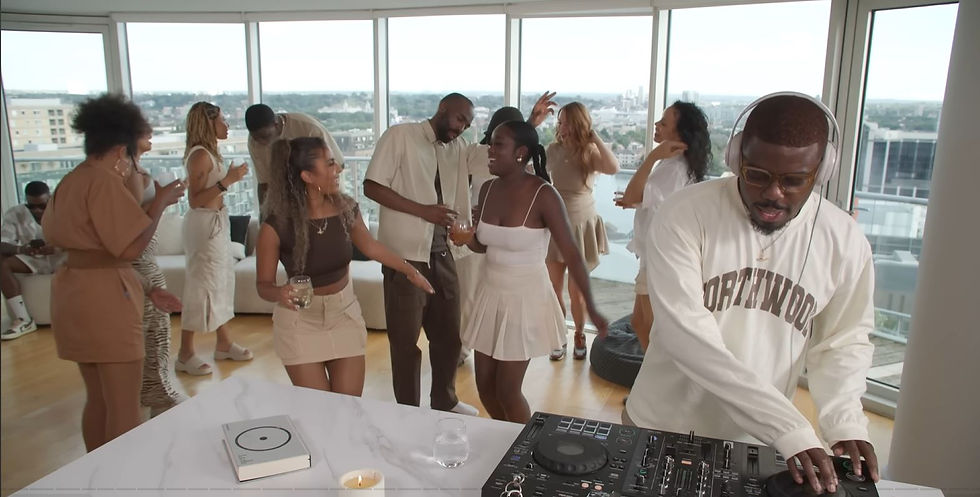
A defining part of aprtment life’s identity is its instantly recognisable aesthetic. “We  didn’t want everyone in a certain uniform, but we wanted everyone in a unified  colour.” 


Inspired partly by Kanye West’s Sunday Service choir performances, the beige  palette became a signature of the space. Johnson adds, “It looked inviting. It was like  we were inviting you into our apartment.” Rather than “when you go to these raves  and everyone’s all in black and just stoosh in the corner,” the lighter tones helped  create a welcoming atmosphere where people felt encouraged to interact. “When  you’re wearing beige, it’s vibrant. You want to converse with someone and you want  to dance. You're not hiding.” 


With its growing popularity, a question naturally arose: did Johnson ever imagine  aprtment life becoming what it is today? Confidently, he responded, “I saw it being  big as an online platform, I had no doubt about that. However, events weren’t on the  cards. In my head, I didn’t think about going to all these countries, having set events,  and doing sessions in different countries. I felt like that was an evolution that just  happened.”


What began as a digital platform gradually expanded beyond London, evolving into  an international series of sessions and live events across cities including Paris,  Nairobi, South Africa, Australia, and the Philippines. This was growth that Johnson  described as both a “pleasant surprise” and “a blessing.” 


Beyond the events themselves, aprtment life sits within a wider cultural conversation  about music discovery and community. In Johnson’s eyes, “Its bringing people joy  through music and shining a light on artists we think deserve recognition. The plan  was a big platform that played great music and sounds that people didn’t know they  were missing, and making people feel like we were family.” 


Part of that mission involves highlighting both established DJs and emerging names.  “We want to honour the ones that have been here for years, like Supa D, spotlight  up-and-comers like Miamor, and create moments with Joekay and people who are  just killing the scene right now.” By giving them a platform to reach new audiences  while celebrating the craft behind DJ culture, aprtment life gives “opportunities to DJs  that we feel need to be seen because they have great taste and help them on their  journey.”


The move to host sessions internationally came largely in response to audience demand. “We saw loads of comments like ‘come to America’. We realised not a lot of  people knew where we were from. At one point everyone thought we were from Paris because of Paris’ name. A lot of people thought we were from LA.” 


Travelling also allowed Johnson and the team to connect with different musical cultures firsthand, something he believes is essential when showcasing genres rooted in specific communities. “We felt like this vibe would be good in different countries. Fábio Luís did an Afro-Latino house, and literally in that room, when I close my eyes, I feel as if I’m in another country. For certain genres like Amapiano, there’s a different feel. We wanted people watching us to see that, and we wanted to feel that as well.” 


When asked which city has stood out the most, Johnson answers immediately.  “South Africa, Cape Town. Jade T, and there’s Loyd and Sir Vincent. I’m seeing the culture right in my face. The way people move there — you have to be part of the culture to dance like that.” Jokingly, he protests, “I’m not a stiff dancer. I can move.  But whatever they were doing, the way they were moving, you had to be born in that country. You had to be part of that culture to move like that.” 


Other locations have surprised him too. Nairobi, Kenya, where aprtment life hosted its first overseas session, revealed a passionate audience that Johnson hadn’t fully anticipated. “After a session or event, people always wait behind and they’re saying thank you for bringing this here. It’s interesting, because it feels bigger than what I think it is. I’m still kind of bamboozled by it.” 


Looking ahead, the goal for aprtment life remains centred around connection. As the founder puts it, “As I mentioned, with weddings or whatever it is, say you go to a house party. There’s a unified connection. Everyone that goes into the apartment should know whose apartment or house it is. A house is very personal, so no one’s  going into the apartment thinking let me chat up some girl or man. Everyone’s going in there and getting to know each other, like I don’t know you, but I know you know Dean or Paris, so we have a connection. In a club you can’t do that, but in a house you can because you have a connection. That’s the idea.” 


From its beginnings as an idea shaped by personal experience to its position within international DJ culture, aprtment life continues to grow, not just in size, but in intention.


Comments


INTERVIEWS
RECENT POSTS

© 2023 by New Wave Magazine. Proudly created by New Wave Studios

bottom of page